
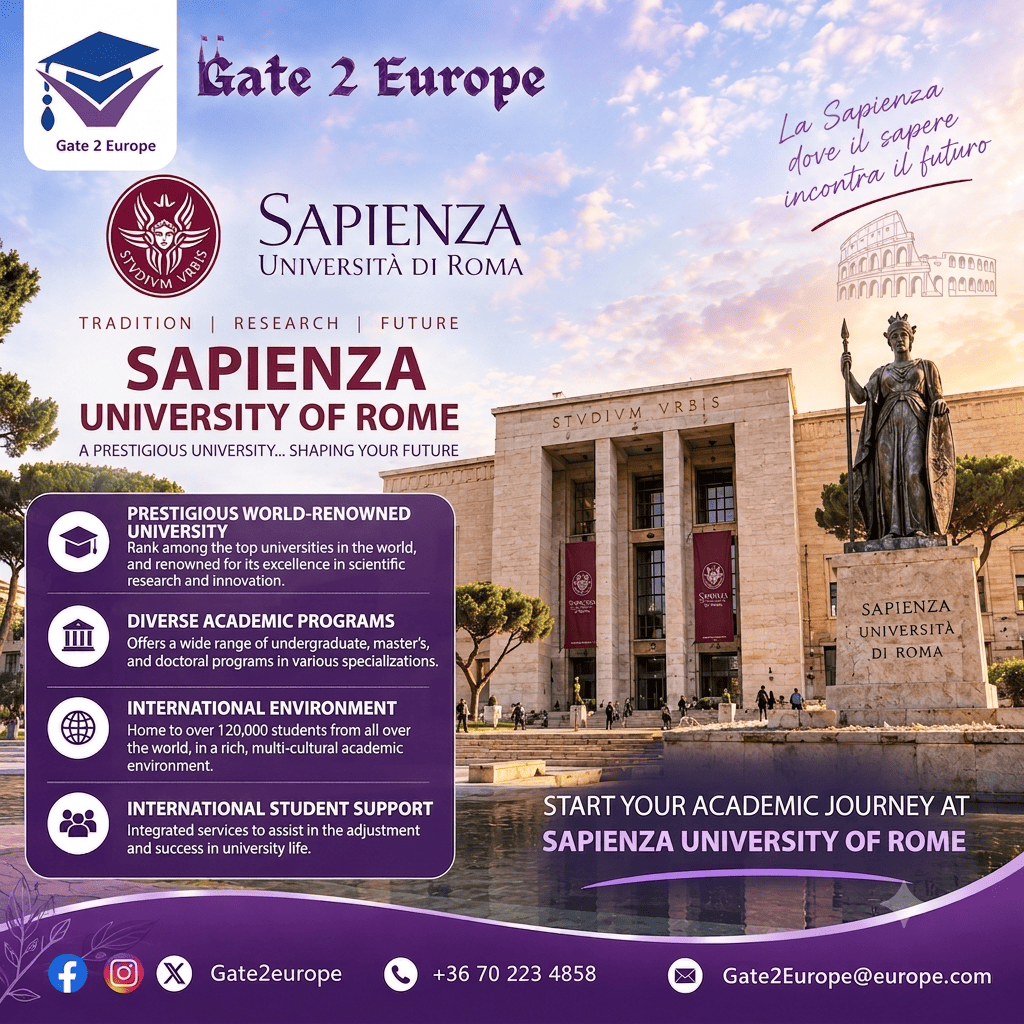
Sapienza University of Rome, Italy: A Premier Academic Destination and Gateway to the Future for International Students
Sapienza University of Rome (Sapienza Università di Roma) is one of the oldest and largest academic institutions not only in Italy, but across the entire world. The university’s history spans over seven centuries; it was founded in 1303 by order of Pope Boniface VIII, evolving through the ages into a major center for knowledge dissemination, critical thinking, and scientific innovation at the heart of the European continent.
Sapienza consistently ranks among the top global universities, holding leading positions in humanities, archaeology, classics, engineering, and medical sciences according to the QS World University Rankings and Times Higher Education.
1. Geographic Location and Campus Environment
Located in the heart of the Italian capital, Rome, Sapienza offers a setting that seamlessly blends rich history with vibrant modern life.
Main Campus (Città Universitaria): Designed by architect Marcello Piacentini and opened in the 1930s, the main campus is a self-contained mini-city situated near the central Termini Railway Station. It houses major academic buildings, historic libraries, and scientific museums.
Specialized Branches: The university’s faculties and teaching hospitals are distributed across key strategic locations in Rome, such as the Faculty of Engineering near the iconic Colosseum and university hospitals like the Policlinico Umberto I.
Student Life: The location gives students the opportunity to live in a city rich in history, arts, and social events, supported by a public transport network that connects all parts of the campus to the rest of the city.
2. Importance of Sapienza University for International Students
Sapienza attracts over 122,000 students annually, including more than 10,000 international students from around the world, creating a multicultural community full of opportunities. Its key advantages for international students include:
English-Taught Programs: The university offers an extensive and growing range of degree programs fully taught in English across all levels (Bachelor’s, Master’s, and PhD).
Affordable Tuition & Scholarships: As a public university, tuition fees at Sapienza are calculated based on the student’s country of origin and family income, typically ranging between €300 and €2,900 per year. Additionally, students are eligible to apply for regional scholarships (LazioDiSCo), which cover full tuition waivers, free university housing, and a monthly stipend.
Comprehensive Student Support: The university features a dedicated International Student Office to assist with residence permits, health insurance, and adapting to academic life in Italy.
Research Facilities & Resources: Students gain access to over 50 university libraries, a vast array of scientific and historical museums, and research initiatives partnered with the European Union.
3. Bachelor’s Degree Programs (Laurea Triennale)
Bachelor’s degree programs at Sapienza generally take 3 academic years to complete (with the exception of single-cycle long medical degrees, which take 6 years).
English-Taught Bachelor’s Programs:
Medicine and Surgery (IMAT): A 6-year single-cycle program taught entirely in English, requiring students to pass the Italian national admission test (IMAT).
Nursing: A practical program designed to prepare healthcare specialists according to international standards.
Applied Computer Science and Artificial Intelligence: Covers computer science, algorithms, and AI development.
Global Humanities / Bioethics: Focuses on international relations, cultural heritage, and moral philosophy.
Admission Requirements for Bachelor’s Degrees:
High school diploma (or equivalent) representing a minimum of 12 years of formal schooling.
Passing the standardized entrance exam required for the specific discipline (e.g., TOLC-E, TOLC-I, SAT, or IMAT for Medicine).
Proof of English language proficiency (typically IELTS 5.5–6.0 or CEFR B2 level), or Italian proficiency if the program is taught in Italian.
4. Master’s Degree Programs (Laurea Magistrale)
Master’s programs at Sapienza span 2 academic years and represent the most popular choice for international students due to the wide array of English-taught specializations.
Key English-Taught Master’s Specializations:
Engineering & Technology: Aeronautical and Space Engineering, Artificial Intelligence and Robotics, Civil Engineering, Data Science, Cybersecurity.
Economics & Business: Business Management, Economics and Finance.
Natural & Applied Sciences: Pharmaceutical Biotechnology, Physics.
Humanities & Social Sciences: Archaeology / Cultural Heritage, International Cooperation and Development.
Admission Requirements for Master’s Degrees:
A relevant Bachelor’s degree.
Pre-selection / qualification evaluation process to verify credit compatibility (ECTS).
Proof of English proficiency at B2 or C1 level (e.g., IELTS 6.0–6.5).
Submission of a CV, Motivation Letter, and academic Recommendation Letters.
5. PhD Programs (Dottorato di Ricerca)
The PhD level at Sapienza is considered among the premier research tracks in Europe, typically lasting 3 to 4 years.
Research Fields & Doctoral Schools:
Engineering & Technical Sciences: Research in robotics, clean energy, nanotechnology, and advanced materials.
Natural Sciences & Mathematics: Research in astrophysics, molecular chemistry, and climate change.
Medical & Life Sciences: Cancer research, genetics, and neurosciences.
Humanities & Legal Sciences: History of Rome, human heritage, philosophy, and international law.
PhD Features & Entry Requirements:
Funded Positions: The university provides numerous accredited positions with monthly salaries/scholarships specifically reserved for PhD candidates.
Application Requirements: Candidates must hold a Master’s degree (or equivalent European 300 ECTS system), submit an academic Research Proposal, and pass an interview (typically conducted online for international applicants).
Important Links:
Italian Public Universities List for International Students | Admission 2026/27 🇮🇹🎓