Study in Germany
Germany is one of the strongest educational destinations in Europe, known for its high-quality universities, student-friendly cities, and affordable living costs.
Germany Map
About Germany
Germany is located in the heart of Europe and is known for its strong economy, excellent education system, and safe, modern cities.
- Capital: Berlin
- Official Language: German
- Currency: Euro (€)
- Population: 83+ million
- EU & Schengen Member
🎥 Introduction Video
Student Life in Germany
🏙 Student Cities
- Berlin – International and diverse
- Munich – Strong economy and high quality of life
- Hamburg – Beautiful coastal city
- Stuttgart – Industrial and modern
- Leipzig – Affordable and student-friendly
🏠 Accommodation
- Student dorms (250–350€)
- Private apartments (350–600€)
- Shared flats (WG)
🚍 Transportation
- Excellent train network
- Large student discounts
- Affordable monthly passes
💰 Cost of Living
- Housing: 250–600€
- Food: 150–250€
- Transport: 30–60€
- Personal expenses: 100–200€
💼 Part-Time Work
- 20 hours per week allowed
- Many opportunities in big cities
- Salary: 10–15€ per hour
💬 Embassy Interview Questions
✔ Why did you choose Germany?
Germany offers high-quality education, affordable living costs, and globally recognized degrees,
making it an ideal destination for my academic and professional goals.
✔ Why this city?
It is a safe, student-friendly city with excellent transportation, affordable housing,
and a multicultural environment that supports international students.
✔ What will you do after graduation?
I plan to return to my home country and work in my field,
applying the knowledge and experience gained in Germany.
Deutschland (anhörenⓘ/?; Vollform des Staatsnamens: Bundesrepublik Deutschland) ist ein Bundesstaat in Mitteleuropa. Es besteht aus 16 Ländern und ist als freiheitlich-demokratischer und sozialer Rechtsstaat verfasst. Die 1949 gegründete Bundesrepublik Deutschland stellt die jüngste Ausprägung des 1871 erstmals gegründeten deutschen Nationalstaats dar. Im Rahmen der Wiedervereinigung Deutschlands wurde Berlin 1990 Bundeshauptstadt und 1991 zum Parlaments- und Regierungssitz bestimmt.
Das Land grenzt an neun Nachbarstaaten und liegt in der gemäßigten Klimazone zwischen Nord- und Ostsee im Norden sowie Bodensee und Alpen im Süden. Deutschland hat circa 83,5 Millionen Einwohner[3] und zählt bei einer Fläche von 357.684 Quadratkilometern mit durchschnittlich 233 Einwohnern pro Quadratkilometer zu den dicht besiedelten Flächenstaaten. Die bevölkerungsreichste deutsche Stadt ist Berlin; weitere Metropolen mit mehr als einer Million Einwohnern sind Hamburg, München und Köln. Der größte Ballungsraum ist das Ruhrgebiet mit 5,1 Millionen Einwohnern.
Funde des Homo heidelbergensis sowie zahlreicher prähistorischer Kunstwerke aus der späteren Altsteinzeit belegen, dass seit 600.000 Jahren Menschen auf dem Gebiet des heutigen Deutschland leben, einige Steinwerkzeuge wurden auf über 1,3 Millionen Jahre datiert.[7] Während der Jungsteinzeit, um 5600 v. Chr., wanderten die ersten Bauern aus Vorderasien ein. Die Römer bezeichneten die Siedlungsgebiete der germanischen Stämme in der Antike als Germania magna.
Durch die Eroberungen Karls des Großen wurden weite Teile des heutigen Deutschlands um 800 erstmals in einem Herrschaftsgebiet zusammengefasst. Infolge der Teilungen des Fränkischen Reichs unter Karls Enkeln entstand im 9. Jahrhundert das Ostfrankenreich, aus dem das bis 1806 bestehende Heilige Römische Reich hervorging. An dessen Stelle wiederum trat 1815 der Deutsche Bund, der sich aus lose miteinander verbundenen souveränen Staaten zusammensetzte. Nach der gescheiterten Märzrevolution von 1848 kam es erst 1871 zur Gründung eines deutschen Nationalstaats, des Deutschen Reichs.
Die rasche Entwicklung vom Agrar- zum Industriestaat vollzog sich während der Gründerzeit in der zweiten Hälfte des 19. Jahrhunderts. Nach dem Ersten Weltkrieg wurde 1918 die Monarchie abgeschafft und eine demokratische Republik konstituiert. Ab 1933 führte die nationalsozialistische Diktatur zu politischer und rassistischer Verfolgung und gipfelte in der Ermordung von sechs Millionen Juden und Angehörigen anderer Minderheiten wie Sinti und Roma. Der vom NS-Staat 1939 begonnene Zweite Weltkrieg endete 1945 mit der Niederlage der Achsenmächte. Das von den Siegermächten besetzte Land wurde 1949 geteilt, nachdem bereits 1945 seine Ostgebiete teils unter polnische, teils sowjetische Verwaltungshoheit gestellt worden waren. Der Gründung der Bundesrepublik als demokratischer westdeutscher Teilstaat mit Westbindung am 23. Mai 1949 folgte die Gründung der sozialistischen Deutschen Demokratischen Republik (DDR) am 7. Oktober 1949 als ostdeutscher Teilstaat unter sowjetischer Hegemonie. Die innerdeutsche Grenze war nach dem Berliner Mauerbau (ab 13. August 1961) abgeriegelt.
Nach der friedlichen Revolution in der DDR 1989 erfolgte die Lösung der deutschen Frage durch die Wiedervereinigung beider Landesteile am 3. Oktober 1990, womit auch die Außengrenzen Deutschlands als endgültig anerkannt wurden. Durch den Beitritt der fünf ostdeutschen Länder sowie die Wiedervereinigung von Ost- und West-Berlin zur heutigen Bundeshauptstadt zählt die Bundesrepublik Deutschland seit 1990 sechzehn Bundesländer.
Die Bundesrepublik Deutschland ist Gründungsmitglied der Europäischen Union und ihrer Vorgänger (Römische Verträge 1957) sowie deren bevölkerungsreichstes Land. Mit 21 anderen EU-Mitgliedstaaten bildet sie eine Währungsunion, die Eurozone. Deutschland ist Mitglied der UN, der OECD, der OSZE, der NATO, der G7, der G20 und des Europarates. Bereits 1951 eröffnete der Hohe Flüchtlingskommissar (UNHCR) ein Verbindungsbüro in der damaligen Bundeshauptstadt Bonn, seit 1991 unterhalten die Vereinten Nationen dort ihren deutschen Sitz („UNO-Stadt“).[8] Die Bundesrepublik Deutschland gilt als einer der politisch einflussreichsten Staaten Europas.[9]
Gemessen am nominalen Bruttoinlandsprodukt ist Deutschland die größte Volkswirtschaft Europas und die drittgrößte der Welt nach den Vereinigten Staaten und China (Stand 2024).[10] Die Deutschen waren 2024 die drittgrößte Export- und Importnation.[11] Sie bilden eine Informations- und Wissensgesellschaft, deren Entwicklung von Automatisierung, Digitalisierung und disruptiven Technologien geprägt ist. Die Verbesserung des deutschen Bildungssystems und die nachhaltige Entwicklung des Landes gelten als zentrale Aufgaben der Standortpolitik. Gemäß dem Index der menschlichen Entwicklung zählt Deutschland zu den sehr hoch entwickelten Ländern.[12][13]
Muttersprache der Bevölkerungsmehrheit ist Deutsch. Daneben gibt es Regional- und Minderheitensprachen und Einwohner mit anderen Muttersprachen, von denen die häufigsten Türkisch und Polnisch sind.[14]
Begriffsgeschichte: deutsch und Deutschland
→ Hauptartikel: *þeudiskaz – deutsch (Etymologie)

Die etymologischen Vorformen des Adjektivs deutsch, etwa das germanische *þeudisk oder das althochdeutsche thiutisk, bedeuteten ursprünglich „zum Volk gehörig“ und bezogen sich auf die Dialekte des kontinental-westgermanischen Dialektkontinuums. Die Bezeichnung Deutschland wird seit dem 15. Jahrhundert verwendet, ist in einzelnen Schriftstücken aber schon früher bezeugt; in der Frankfurter Übersetzung der Goldenen Bulle (um 1365) heißt es Dutschelant. Davor sind nur Wortfügungen des Attributs deutsch mit Land belegt, beispielsweise in der unbestimmten Singularform „ein deutsches Land“ oder der bestimmten Pluralform „die deutschen Länder“, nicht aber in der bestimmten Singularform „das deutsche Land“. Gemeint waren Länder mit einer Führungsschicht, die sich auf den politischen Herrschaftsanspruch des (Ost-)Fränkischen, ab dem 10. Jahrhundert des Heiligen Römischen Reiches (962–1806) bezog. Die Bezeichnung wurde damit vor allem für (vor-)staatliche Gebilde im deutschen Sprach– oder Herrschaftsgebiet verwendet, das über Jahrhunderte große Veränderungen erlebte.
Das Heilige Römische Reich, ursprünglich nur als „Reich“ (lateinisch Imperium) bezeichnet, erhielt mehrere Namenszusätze: „heilig“ seit Mitte des 12. Jahrhunderts, „römisch“ seit Mitte des 13. Jahrhunderts, und im späten 15. bis 16. Jahrhundert etablierte sich zeitweise „deutscher Nation“ (Heiliges Römisches Reich Deutscher Nation). Erst im 16. Jahrhundert kam die Bezeichnung „Teutschland“ für die vorher so bezeichneten „deutschen Lande“ auf.[15] Bald bürgerte sich in der zeitgenössischen Literatur eine Gleichsetzung von Reich und Teutschland ein, die schließlich als Synonyma verwendet wurden (etwa durch den Hallenser Juristen Johann Peter von Ludewig 1735).[16]
Ein Bewusstsein, dass nicht der jeweilige Territorialstaat, sondern Deutschland als Ganzes als Vaterland anzusehen sei, begann sich erst in den napoleonischen Kriegen auszubreiten. Zuvor hatte etwa Friedrich Schiller streng zwischen einem geistigen und einem politischen Deutschland unterschieden:
„Deutschland, aber wo liegt es? Ich weiß das Land nicht zu finden.
Wo das gelehrte beginnt, hört das politische auf.“
– Friedrich Schiller: Xenien, in: „Musen-Almanach für das Jahr 1797“
Auch die Möglichkeit einer geeinten Nation sah er skeptisch:
„Zur Nation euch zu bilden, ihr hoffet es, Deutsche, vergebens.
Bildet, ihr könnt es, dafür freier zu Menschen euch aus.“
– Friedrich Schiller, ebenda
Deutsche Größe, so der Titel eines unvollendeten Gedichts aus dem Jahr 1801, sah er allein im Geistigen.[17] Noch 1813 sprach Achim von Arnim von Deutschland als einem „hohlen Wortideale“, dem er „alles Herrliche der einzelnen deutschen Völker“ (im Plural) gegenüberstellte.[18]
1806 erschien im Verlag von Johann Philipp Palm die umfangreiche antifranzösische Flugschrift Deutschland in seiner tiefen Erniedrigung. Das einsetzende politische Verständnis des Namens Deutschland ging zunächst nur von einer kleinen Gruppe von Intellektuellen und Politikern wie Ernst Moritz Arndt, Friedrich Ludwig Jahn, Johann Gottlieb Fichte oder Heinrich Friedrich Karl vom und zum Stein aus, entfaltete aber bereits während der Befreiungskriege eine erhebliche Mobilisierungswirkung.[19] Auch das Kaisertum Österreich und das Königreich Preußen bezogen sich nun positiv auf Deutschland: Erzherzog Karl von Österreich-Teschen erließ 1809 zu Beginn des Fünften Koalitionskriegs einen Aufruf An die deutsche Nation, in dem er versicherte: „Unsere Sache ist die Sache Deutschlands“.[20] Der preußische König Friedrich Wilhelm III. kündigte in der Proklamation von Kalisch am 19. März 1813 „den Fürsten und Völkern Deutschlands die Rückkehr der Freiheit und Unabhängigkeit“ an.[21] Dieses Deutschland wurde als der deutsche Sprachraum definiert (Arndt: Des Deutschen Vaterland, 1813; ähnlich noch 1841 Hoffmann von Fallerslebens Lied der Deutschen).[22] Es wurde nicht mehr als Reich, sondern als Nation verstanden; die deutsche Nationalbewegung setzte sich in den folgenden Jahrzehnten dafür ein, alle deutschen Territorien in einem Nationalstaat zusammenzufassen. Dies misslang zunächst; auf dem Wiener Kongress 1814/15 wurden stattdessen die Territorialstaaten wiederhergestellt und in einem Staatenbund zusammengefasst, dem Deutschen Bund.[23] Dieser wurde ebenfalls als Deutschland bezeichnet, umfasste aber einige mehrheitlich nicht-deutschsprachige Territorien wie Böhmen und Mähren, während andere, mehrheitlich deutschsprachige Gebiete wie Ostpreußen nicht dazugehörten. Gleichwohl blieb die Nationalbewegung zunächst ein Elitenprojekt. Massenwirksamkeit entfaltete sie erst in der Rheinkrise 1840.[24]
Ab der Reichsgründung 1871 setzte ein Bedeutungswandel ein, von Deutschland als Kulturnation hin zur Staatsbezeichnung, unter geografischer Einschränkung auf das heutige Gebiet:
Das Kaisertum Österreich wurde 1871 nicht Teil des Deutschen Reichs. Die deutschsprachigen Bewohner Österreichs empfanden sich aber auch weiterhin als Deutsche. Als am Ende des Ersten Weltkriegs der Vielvölkerstaat zerfiel, wollten die Deutschösterreicher sich dem Deutschen Reich anschließen. Das untersagte jedoch der Vertrag von Saint-Germain. So begannen sich unterschiedliche nationale Identitäten zu entwickeln. Die Begriffe deutsch und Deutschland wurden zunehmend nur mit dem Deutschen Reich identifiziert. Dieser Prozess wurde zunächst unterbrochen, als 1938 unter nationalsozialistischer Herrschaft der Anschluss Österreichs an das Deutsche Reich erfolgte. Die Distanzierung vom Nationalsozialismus nach dem Zweiten Weltkrieg führte in Österreich zur Distanzierung vom Begriff Deutschland und zur Festigung einer eigenen nationalen Identität der Österreicher. Im Zuge der politischen Neuorganisation des fortbestehenden Gesamtstaates lehnte der Parlamentarische Rat in Westdeutschland eine Fortführung des Staatsnamens Deutsches Reich wegen seines „aggressiven Akzents“ ab und verwendete erstmals Deutschland als Staatsbezeichnung in der damals konstituierten „Bundesrepublik Deutschland“. In den Beratungen sagte Theodor Heuss 1948: „Mit dem Wort Deutschland geben wir dem Ganzen ein gewisses Pathos … sentimentaler und nicht machtpolitischer Art.“[25] Die Deutsche Demokratische Republik nutzte Deutschland nicht im Staatsnamen, aber als synonyme Bezeichnung für DDR in Art. 1 der Verfassung von 1949. Später verwendete die DDR fast nur noch das Adjektiv deutsch beziehungsweise den Namenszusatz „… der DDR“ für staatliche Hoheitsbezeichnungen. Mit der deutschen Einheit 1990 konnte Deutschland zur amtlichen Kurzform der Staatsbezeichnung werden.[26]
Geographie
→ Hauptartikel: Geographie Deutschlands
Physische Geographie
.svg "Study in Germany")
Die naturräumlichen Großregionen sind von Nord nach Süd: das Norddeutsche Tiefland, die Mittelgebirgszone und das Alpenvorland mit den Alpen.
Geologie
→ Hauptartikel: Geologie Deutschlands

Deutschland gehört geologisch zu Westeuropa, das heißt zu jenem Teil des Kontinents, der dem präkambrisch konsolidierten „Ur-Europa“ (Osteuropa einschließlich eines Großteils Skandinaviens, vgl. Baltica) erst im Verlauf des Phanerozoikums sukzessive durch Kontinent-Kontinent-Kollisionen (Gebirgsbildungen) angegliedert wurde. Die entsprechenden Krustenprovinzen (Grundgebirgsprovinzen) werden klassisch vereinfachend (Ost-)Avalonia (vgl. kaledonische Gebirgsbildung) und Armorica (vgl. variszische Gebirgsbildung) genannt. Die jüngste Krustenprovinz ist das Alpen-Karpaten-Orogen (vgl. alpidische Gebirgsbildung), an dem Deutschland nur mit dem äußersten Süden Bayerns Anteil hat und das im Gegensatz zu den beiden anderen tektonischen Provinzen ein aktives Orogen darstellt.
Die heutige Oberflächengeologie Deutschlands, das heißt das Muster aus verschieden alten und verschieden aufgebauten Gesteinskomplexen, wie es in geologischen Karten vielfach abgebildet ist, entstand erst im Verlauf der letzten 30 bis 20 Millionen Jahre im jüngeren Känozoikum und wurde von zwei Ereignissen maßgeblich geprägt: der Alpidischen Gebirgsbildung und dem Quartären Eiszeitalter.
Das Quartäre Eiszeitalter formte die vergleichsweise eintönige Oberflächengeologie Norddeutschlands und des Alpenvorlandes mit ihren Moränenablagerungen und sonstigen Begleiterscheinungen großflächiger Vergletscherungen (vgl. glaziale Serie).
Die Oberflächengeologie der Mitte und des überwiegenden Teils des Südens Deutschlands ist das Ergebnis bedeutender bruchtektonischer Hebungen und Senkungen, die auf die Fernwirkung der Alpidischen Gebirgsbildung zurückgehen. Hierbei wurden teils alte (überwiegend Paläozoikum), variszisch gefaltete Grundgebirgskomplexe (Schiefergebirge und Kristallin) aus dem Untergrund herausgehoben und großflächig freigelegt (u. a. Rheinisches Schiefergebirge, Harz, Erzgebirge), teils sank die Erdkruste ein und bildete Sedimentationsräume, die mehr oder weniger mächtige känozoische Sedimentabfolgen aufnahmen (Oberrheingraben, Niederrheingraben, Hessische Senke, Molassebecken). Eine tektonische Zwischenstellung nehmen die Tafelländer mit ihren ungefalteten mesozoischen Schichtenfolgen ein, dominiert von Trias und Jura (Thüringer Becken, Süddeutsches Schichtstufenland).
Relief

Das geologisch junge Faltengebirge der Alpen ist das einzige Hochgebirge, an dem Deutschland Anteil hat. Die deutschen Alpen, die sich zur Gänze im Bundesland Bayern befinden, weisen die einzigen Gebirgsgipfel mit mehr als 2000 m ü. NHN auf. Der Gipfel der Zugspitze (2962 m ü. NHN), den sich Deutschland mit Österreich teilt, ist der höchstgelegene Punkt des Landes.

Die deutschen Mittelgebirge erstrecken sich vom Nordrand der Mittelgebirgsschwelle bis zum Alpenrand und zum Oberrhein mit dem Bodensee. Sie nehmen tendenziell von Nord nach Süd an Höhe und Ausdehnung zu. Höchster Mittelgebirgsgipfel ist der Feldberg im Schwarzwald (1493 m ü. NHN), gefolgt vom Großen Arber im Bayerischen Wald (1456 m ü. NHN). Gipfel über 1000 m ü. NHN besitzen außerdem das Erzgebirge, das Fichtelgebirge, die Schwäbische Alb und der Harz, der sich recht isoliert als nördlichstes unter den höchsten deutschen Mittelgebirgen mit dem Brocken auf 1141 m ü. NHN erhebt. Nördlich der Mittelgebirgsschwelle erreichen nur noch einige Berge innerhalb der eiszeitlichen Endmoränenzüge mehr als 100 m ü. NHN, von denen die Heidehöhe in Schraden (Südlicher Landrücken im brandenburgisch-sächsischen Grenzgebiet) mit 201 m ü. NHN der höchste ist.
Die tiefste allgemein zugängliche Landesstelle Deutschlands liegt bei 3,54 m unter NHN in einer Senke bei Neuendorf-Sachsenbande in der Wilstermarsch (Schleswig-Holstein).[27] Ebenfalls in diesem Bundesland befindet sich die tiefste Kryptodepression: Sie liegt mit 39,6 m unter NHN am Grund des Hemmelsdorfer Sees nordöstlich von Lübeck. Der tiefste künstlich geschaffene Geländepunkt liegt bei 267 m unter NHN am Grund des Tagebaus Hambach östlich von Jülich in Nordrhein-Westfalen.
Klima
→ Hauptartikel: Klima in Deutschland
Deutschland gehört vollständig zur gemäßigten Klimazone Mitteleuropas im Bereich der Westwindzone und befindet sich im Übergangsbereich zwischen dem Seeklima in Westeuropa und dem Kontinentalklima in Osteuropa. Das Klima in Deutschland wird unter anderem vom Golfstrom beeinflusst, durch den das durchschnittliche Temperaturniveau für die Breitenlage ungewöhnlich hoch ist.
Die mittlere Jahresdurchschnittstemperatur, bezogen auf die Normalperiode 1961–1990,[28] beträgt im bundesweiten Gebietsmittel 8,2 °C, die mittleren Monatsdurchschnittstemperaturen liegen zwischen −0,5 °C im Januar und 16,9 °C im Juli. Der mittlere jährliche Niederschlag beträgt 789 Millimeter. Die mittlere monatliche Niederschlagshöhe liegt zwischen 49 Millimetern im Februar und 85 Millimetern im Juni.
Die tiefste offiziell anerkannte in Deutschland gemessene Temperatur betrug −37,8 °C; sie wurde 1929 in Wolnzach registriert. Die bisher höchste Temperatur betrug 41,2 °C und wurde am 25. Juli 2019 in Duisburg-Baerl und in Tönisvorst am Niederrhein gemessen.[29]
Klimawandel

→ Hauptartikel: Folgen der globalen Erwärmung in Deutschland
Auswertungen der Wetterbeobachtungen zeigen, dass die mittlere Temperatur in Deutschland im Zeitraum 1881 bis 2022 um ca. 1,7 °C gestiegen ist (linearer Trend), während der weltweite Temperaturanstieg (über See- und Landflächen) im gleichen Zeitraum nur 1,1 °C betrug.[30]
Gegenwärtige Prognosen für das Klima in Deutschland stellen bis zur Mitte des 21. Jahrhunderts einen Anstieg um 2,3 °C im Jahresmittel in Aussicht, der sich bis 2100 weiter auf 4,7 °C erhöhen könnte (bis 6 °C in Sommermonaten).[31][32] Bis 2050 könnte der volkswirtschaftliche Schaden 900 Milliarden Euro betragen, zuzüglich Folgekosten durch gesundheitliche Schäden, vorzeitige Todesfälle und sozioökologische Kettenreaktionen.[33][34]
Gewässer
Von den sechs Strömen mit den größten Einzugsgebieten entwässern Rhein, Elbe, Weser und Ems über die Nordsee und die Oder über die Ostsee in den Atlantik, während die Donau ins Schwarze Meer fließt und somit hydrographisch dem Mittelmeer zuzurechnen ist. Die Einzugsgebiete dieser beiden Systeme werden durch die europäische Hauptwasserscheide voneinander getrennt.

Der in der Schweiz entspringende Rhein dominiert den Südwesten und Westen. Auf 865 Kilometern fließt er durch bzw. an der Grenze zu Deutschland, bevor er über die Niederlande in die Nordsee mündet. Seine wichtigsten deutschen Zuflüsse sind Neckar, Main, Mosel und Ruhr. Der Rhein hat eine große wirtschaftliche Bedeutung und ist eine der am stärksten befahrenen Wasserstraßen Europas. Die Donau entwässert im Süden auf 647 Kilometern fast das gesamte deutsche Alpenvorland und fließt weiter nach Österreich und Südosteuropa. Ihre wichtigsten deutschen Zuflüsse sind Iller, Lech, Isar und Inn. Den Osten Deutschlands durchfließt auf 725 Kilometern die in Tschechien entspringende Elbe. Ihre wichtigsten deutschen Nebenflüsse sind Saale und Havel. Auf 179 Kilometern ist die Oder, wie im weiteren Verlauf auch ihr wichtigster Zufluss, die Neiße, der Grenzfluss zu Polen. Einzig das Einzugsgebiet der 452 Kilometer langen Weser liegt vollständig in Deutschland. Sie speist sich aus den Flüssen Werra und Fulda und entwässert den mittleren Norden. Die Ems durchfließt auf 371 Kilometern den äußersten Nordwesten des Landes. Ihr Einzugsgebiet erstreckt sich auch auf Teile der Niederlande.
Die natürlichen Seen sind überwiegend glazialen Ursprungs. Daher finden sich die meisten der großen Seen im Alpenvorland, in der Holsteinischen Schweiz und in Mecklenburg. Der größte vollständig zum deutschen Staatsgebiet gehörende See ist die Müritz, die Teil der Mecklenburgischen Seenplatte ist. Der größte See mit deutschem Anteil ist der Bodensee, an den auch Österreich und die Schweiz grenzen. Im Westen und Osten Deutschlands gibt es viele, durch die Rekultivierung von Braunkohletagebauen oder Industriebrachen entstandene, künstliche Seen, wie das Leipziger Neuseenland oder den Dortmunder Phoenix-See.
Inseln
_10.JPG "Study in Germany")
Im Wattenmeer, der niederländischen, deutschen und dänischen Nordseeküste unmittelbar vorgelagert, liegen die Friesischen Inseln. Während die Nordfriesischen Inseln Festlandsreste sind, die durch Landsenkung und nachfolgende Überflutung von der Küste getrennt wurden, handelt es sich bei den Ostfriesischen Inseln um Barriereinseln, die aus durch küstenparallele Strömungen sowie Wellen- und Gezeitendynamik angespülten Sedimenten entstanden. Das inmitten der Deutschen Bucht gelegene Helgoland ist die am weitesten vom Festland entfernt liegende bewohnte deutsche Insel. Sie geht auf den Aufstieg eines Salzstockes im Untergrund der Nordsee zurück.
Die größten deutschen Inseln in der Ostsee sind (von West nach Ost) Fehmarn, Poel, Hiddensee, Rügen und Usedom. Rügen ist zugleich die größte deutsche Insel. Größte Halbinsel ist Fischland-Darß-Zingst. Mit Ausnahme von Fehmarn sind diese Landflächen Teil einer Boddenküste, das heißt einer nacheiszeitlich gefluteten und nachfolgend durch Anlandungsvorgänge modifizierten Grundmoränenlandschaft.
Die größten und bekanntesten Inseln in Binnengewässern sind Reichenau, Mainau und Lindau im Bodensee sowie die Herreninsel im Chiemsee.
Flora

Der Naturraum Deutschland liegt in der kühlgemäßigten Klimazone; von West nach Ost kennzeichnet seine natürliche Vegetation den Übergang vom Westseitenseeklima zum Kontinentalklima. Die Flora wäre ohne menschlichen Einfluss hauptsächlich von Laub- und Mischwäldern geprägt, ausgenommen nährstoffarme oder trockene Standorte wie Felskuppen, Heideniederungen und Moorlandschaften sowie die alpinen und subalpinen Hochlagen, die äußerst vegetationsarm sind und in ihrem Klima der kaltgemäßigten Klimazone ähneln.
Örtlich weist die Flora in Deutschland eine hohe Diversifikation durch Standortfaktoren des Geländes und der mesoklimatischen Lage auf. Der Gesamtbestand der in Deutschland wild lebenden Pflanzenarten wird auf über 9.500 Arten geschätzt, davon sind fast 3.000 Arten Samenpflanzen, 74 Farnpflanzen, über 1.000 Moose und etwa 3.000 Kieselalgen. Dazu kommen rund 14.000 Pilz- und 373 Schleimpilzarten.[35] Insbesondere auf Brach- und Störflächen finden sich heute eine Reihe eingeführter Arten wie die Robinie und das Drüsige Springkraut.

Derzeit bedeckt der Wald in Deutschland rund 30 Prozent der Landfläche. Damit ist Deutschland eines der waldreichsten Länder in der Europäischen Union. Die aktuelle Baumartenzusammensetzung entspricht nur zum geringen Teil den natürlichen Gegebenheiten und wird hauptsächlich von der Forstwirtschaft bestimmt. Die häufigsten Baumarten sind mit 26,0 Prozent Flächenanteil die Gemeine Fichte, gefolgt von der Waldkiefer mit 22,9 Prozent, der Rotbuche mit 15,8 Prozent und den Eichen mit 10,6 Prozent.[36]
Rund die Hälfte der Staatsfläche wird landwirtschaftlich genutzt; laut Statistischem Bundesamt waren es 179.578 Quadratkilometer am 31. Dezember 2024.[37] Neben der Nutzung als Dauergrünland wird auf einem Großteil Ackerbau betrieben, seit der Stein- bzw. der Bronzezeit überwiegend mit Nutzpflanzen, die nicht natürlich in Mitteleuropa vorkommen (die meisten der Getreidearten aus dem Vorderen Orient, Kartoffel und Mais aus Amerika). In den Flusstälern, unter anderem von Main, Mosel, Ahr und Rhein, wurde die Landschaft vielfach für den Weinanbau umgestaltet.
Die Bewahrung der Natur ist in Deutschland öffentliche Aufgabe und in Art. 20a Grundgesetz verankertes Staatsziel. Dem Naturschutz dienen 16 Nationalparks (siehe Nationalparks in Deutschland), 19 Biosphärenreservate, 105 Naturparks sowie tausende von Naturschutzgebieten, Landschaftsschutzgebieten und Naturdenkmälern.
Fauna
_of_central_Poland_in_flight_(3).jpg "Study in Germany")
In Deutschland sind etwa 48.000 Tierarten nachgewiesen, darunter 104 Säugetier-, 328 Vogel-, 13 Reptilien-, 22 Lurch- und 197 Fischarten sowie über 33.000 Insektenarten, womit das Land „aufgrund der erdgeschichtlichen Entwicklung und der geographischen Lage zu den eher artenärmeren Gebieten“ zählt.[38] Zu diesen Arten kommen über 1.000 Krebs-, fast 3.800 Spinnen-, 635 Weichtiere sowie über 5.300 andere Wirbellose.
Zu den in Deutschland heimischen wilden Säugetieren zählen unter anderem Rehe, Wildschweine, Rot- und Damhirsche sowie Füchse, Marder und Luchse. Biber und Otter sind seltene Bewohner der Flussauen, mit teilweise wieder steigenden Beständen. In den bayerischen Alpen leben Alpensteinbock, Alpenmurmeltier und die Gämse; letztere ist auch in verschiedenen Mittelgebirgen anzutreffen. Andere Großsäuger, die in früherer Zeit auf dem Gebiet des heutigen Deutschlands lebten, wurden ausgerottet: Wildpferd, Auerochse (15. Jahrhundert), Wisent (16. Jahrhundert), Braunbär (19. Jahrhundert), Wolf (19. Jahrhundert), Elch (20. Jahrhundert). Während Elche heute gelegentlich aus Nachbarländern zuwandern, haben sich Wölfe aus Polen kommend wieder fest in Deutschland etabliert und um die Jahrtausendwende erstmals Nachwuchs geboren. Im Zeitraum 2023/2024 existierten in Deutschland insgesamt 209 bestätigte Rudel, 46 Paare und 19 territoriale Einzeltiere, die größtenteils in den Ländern Sachsen, Brandenburg, Niedersachsen und Mecklenburg-Vorpommern leben.[39][40] 2013 wurde eine Herde Wisente im Rothaargebirge ausgewildert und hat sich inzwischen auf etwa 40 Tiere vermehrt. Im Oktober 2019 wurde im Landkreis Garmisch-Partenkirchen ein vermutlich aus Italien zugewanderter Braunbär von einer Wildtierkamera fotografiert. In den darauf folgenden Monaten konnte das Tier mehrfach erneut nachgewiesen werden.[41] Bärensichtungen gab es in den folgenden Jahren im deutschen Alpenraum immer wieder. Im Jahr 2023 lagen 13 Bärennachweise in verschiedenen Landkreisen vor.[42] Inzwischen leben auch ursprünglich hier heimische Luchse wieder in Deutschland, allerdings in geringer Bestandsdichte.
Vom Seeadler, der als Vorlage für das deutsche Wappentier gilt, gibt es wieder etwa 500 Paare, vor allem in Mecklenburg-Vorpommern und Brandenburg. Der Steinadler kommt nur noch in den Bayerischen Alpen vor, wo auch der dort ausgerottete Bartgeier aus der Schweiz und Österreich wieder Einzug hält. Die häufigsten Greifvögel sind heute Mäusebussard und Turmfalke, der Bestand an Wanderfalken ist deutlich geringer. Über die Hälfte des Gesamtbestandes an Rotmilanen brütet in Deutschland. Viele Vögel profitieren als Kulturfolger von der Anwesenheit des Menschen, insbesondere die in Städten lebenden Stadttauben, Amseln (frühere Waldvögel), Spatzen und Meisen, für deren Überleben auch die Winterfütterung sorgt, sowie Krähen und Möwen auf Müllkippen. Das Wattenmeer ist Rastplatz für zehn bis zwölf Millionen Zugvögel pro Jahr.

Der früher in den Flüssen häufige Lachs wurde im Zuge der Industrialisierung weitgehend ausgerottet, aber in den 1980er-Jahren im Rhein wieder angesiedelt. In Deutschland wurde der letzte Stör 1969 gefangen. In vielen Teichen werden die von den Römern eingeführten Karpfen gehalten. Die von Berufsfischern Mitte des 20. Jahrhunderts als Beutekonkurrenten nahezu ausgerotteten und inzwischen geschützten Arten Seehund und Kegelrobbe – letztere das größte in Deutschland heimische Raubtier – sind heute wieder mit einigen tausend Exemplaren an den deutschen Küsten vertreten. In Nord- und Ostsee kommen acht Walarten vor, darunter der Schweinswal, und mit dem Gemeinen Delfin auch eine Delfinart.
Die artenarme Reptilienfauna umfasst beispielsweise Ringelnatter, Kreuzotter, Zauneidechse und die vom Aussterben bedrohte Europäische Sumpfschildkröte. Amphibien wie Salamander, Frösche, Kröten, Unken und Molche stehen in Deutschland alle unter Artenschutz, und die Hälfte der rund 20 Arten wird auf der nationalen Roten Liste bedrohter Tierarten geführt.[43]
Zu den – teils invasiven – Neozoen in Deutschland (eingeschleppten Tierarten) gehören Waschbär, Marderhund, Bisamratte, Nutria, Halsbandsittich, Kanadagans und Nilgans.
Humangeographie

Deutschland hat insgesamt neun Nachbarstaaten: Im Norden grenzt Deutschland an Dänemark, im Nordosten an Polen, im Osten an Tschechien, im Südosten an Österreich, im Süden an die Schweiz, im Südwesten an Frankreich, im Westen an Luxemburg und an Belgien und im Nordwesten an die Niederlande. Die Grenzlänge beträgt insgesamt 3876 Kilometer.[44]
In Deutschland werden insgesamt 51 Prozent der Landesfläche landwirtschaftlich genutzt (2016), Wälder bedecken weitere 30 Prozent. 14 Prozent werden als Siedlungs- und Verkehrsfläche genutzt. Wasserflächen kommen auf zwei Prozent, die restlichen drei Prozent verteilen sich auf sonstige Flächen, zumeist Ödland und auch Tagebaue.[37]
Verwaltungsgliederung
Die föderal aufgebaute Bundesrepublik besteht aus 16 Gliedstaaten, die offiziell als Länder (Bundesländer) bezeichnet werden. Die Stadtstaaten Berlin und Hamburg bestehen jeweils aus gleichnamigen Einheitsgemeinden, während die Freie Hansestadt Bremen, als dritter Stadtstaat, mit Bremen und Bremerhaven zwei separate Stadtgemeinden umfasst. Im Unterschied zu anderen Föderalstaaten gibt es in Deutschland keine bundesunmittelbaren Gebiete.
Die Gemeinden sind die kleinsten demokratisch verfassten, rechtlich selbstständigen Gebietskörperschaften und Verwaltungseinheiten Deutschlands.[45] Sie haben aufgrund ihrer genossenschaftlichen Prägung, die bis ins Mittelalter zurückreicht, eine lange Tradition.[46] Heute sind die Gemeinden in Deutschland, mit Ausnahme der Stadtstaaten und der meisten kreisfreien Städte, in Landkreisen und anderen Gemeindeverbänden zusammengefasst.[47] Es existieren 401 Gebietskörperschaften auf Kreisebene, davon 294 Kreise sowie 107 kreisfreie Städte. Sie sind untergliedert in insgesamt 10.747 Gemeinden (Stand Januar 2026), Tendenz sinkend, sowie 194 größtenteils unbewohnte gemeindefreie Gebiete. Kreise und Gemeinden unterliegen dem Kommunalverfassungsrecht des jeweiligen Bundeslandes und sind daher bundesweit unterschiedlich organisiert. Der Landkreis ist damit sowohl überörtliche kommunale Gebietskörperschaft als auch untere staatliche Verwaltungsbehörde, er hat eine eigene Vertretungskörperschaft, den Kreistag (Art. 28 Abs. 1 S. 2 GG), und nimmt verschiedene Aufgaben der „überörtlichen Gemeinschaft“ für die kreisangehörigen Gemeinden wahr.[48]
Die Kommunen sind staatsrechtlich Teil der Länder, womit sie deren Aufsichts- und Weisungsrecht unterliegen und demnach über keine eigene staatliche Hoheitsmacht verfügen.[49] Die Selbstverwaltungsgarantie des Art. 28 Abs. 2 GG – einerseits eine sogenannte institutionelle Rechtssubjektsgarantie, woraus folgt, dass es Gemeinden im Staatsaufbau überhaupt geben muss, andererseits ein subjektiv-öffentliches Recht mit Verfassungsrang – unterscheidet zwischen den Gemeinden, denen dieses Recht vollumfänglich zugesprochen wird, und den Gemeindeverbänden (Landkreisen), denen es in lediglich abgestufter Form zugesprochen wird. Somit besteht für die Aufgabenabgrenzung zwischen Gemeinden und Kreisen ein klares Regel-Ausnahme-Verhältnis zugunsten der Gemeinden (Subsidiaritätsprinzip).[50] Das Bundesverfassungsgericht hat hinsichtlich der „Angelegenheiten der örtlichen Gemeinschaft“, also der in Art. 28 Abs. 2 Satz 1 GG gewährleisteten Befugnis, in diesem Aufgabenbereich die Geschäfte eigenverantwortlich zu führen (sogenannte objektive Rechtsinstitutionsgarantie), den Vorrang der Gemeindeebene vor der Kreisebene nach Maßgabe der Gesetze festgestellt: Hiernach gilt für die Gemeinden „als Essentiale“ und „identitätsbestimmendes Merkmal der gemeindlichen Selbstverwaltung“ das Prinzip der „‚Universalität‘ des gemeindlichen Wirkungskreises“,[51] im Gegensatz zur speziellen Kompetenz der Gemeindeverbände kraft ausdrücklicher gesetzlicher Zuweisung, womit es auch keine feststehenden Gemeindeverbandshoheiten gibt.[52]
Ballungsgebiete


In Deutschland werden Verdichtungs- und Ballungsräume (Agglomerationen) nicht statistisch genau abgegrenzt. Es gibt (Stand 31. Dezember 2024) 80 Großstädte (ab 100.000 Einwohner), davon 15 mit mehr als 500.000 Einwohnern, historisch bedingt überwiegend im Westen und Südwesten Deutschlands. Diese entlang des Rheins verlaufenden Ballungsräume bilden den Mittelteil der zentralen europäischen Bevölkerungskonzentration (Blaue Banane). Die meisten Agglomerationen sind monozentrisch, das Ruhrgebiet hingegen ist eine (polyzentrische) Konurbation. Mit seinen zahlreichen Zentren hat Deutschland, anders als etwa die Nachbarländer Österreich mit seiner Hauptstadt Wien und Dänemark mit Kopenhagen, keine Primatstadt. Trotz der Vielzahl großer Städte lebte zum 31. Dezember 2024 etwas weniger als ein Drittel (26,8 Millionen) der Einwohner Deutschlands in Großstädten. Nahezu 15 Millionen Einwohner leben in den 15 deutschen Städten mit mehr als einer halben Million Einwohnern, was etwa 18 % aller Einwohner entspricht.[69][70]
Auf dem Gebiet Deutschlands wurden von der Ministerkonferenz für Raumordnung zwischen 1995 und 2005 insgesamt elf Europäische Metropolregionen festgelegt. Diese gehen über die entsprechenden Agglomerationen weit hinaus. Zum Beispiel gehören Köln/Düsseldorf/Dortmund/Essen zur Metropolregion Rhein-Ruhr, Leipzig/Halle/Chemnitz zur Metropolregion Mitteldeutschland. Eine weitere ist die Metropolregion Rhein-Neckar um Ludwigshafen/Mannheim/Heidelberg, die neben dieser Agglomeration auch Teile der Pfalz und des Odenwaldes umfasst.
| Siedlungsgebiet | Stadt 2 | Agglomeration[71] | Metropolregion | |
|---|---|---|---|---|
| 1 | Berlin | 3.700.577 | 4.630.000 | 6.120.000 |
| 2 | Hamburg | 1.869.473 | 2.820.000 | 5.425.000 |
| 3 | München | 1.505.036 | 2.210.000 | 5.990.000 |
| 4 | Köln | 1.025.523 | 4.910.000 | 10.680.000 |
| 5 | Frankfurt am Main | 760.656 | 2.710.000 | 5.720.000 |
| 6 | Düsseldorf | 619.444 | 4.910.000 | 10.680.000 |
| 7 | Stuttgart | 612.663 | 2.360.000 | 5.300.000 |
| 8 | Leipzig | 611.850 | 1.200.000 | 2.400.000 |
| 9 | Dortmund | 600.880 | 5.610.000 | 10.680.000 |
| 10 | Bremen | 588.413 | 990.000 | 2.730.000 |
| 11 | Essen | 573.618 | 5.610.000 | 10.680.000 |
| 12 | Dresden | 564.904 | 830.000 | 2.400.000 |
| 13 | Nürnberg | 531.159 | 1.350.000 | 3.560.000 |
| 14 | Hannover | 522.803 | 1.130.000 | 3.830.000 |
| 15 | Duisburg | 500.810 | 5.610.000 | 10.680.000 |
Germany full information
| Federal Republic of GermanyBundesrepublik Deutschland | |
|---|---|
| FlagCoat of arms | |
| Anthem: “Das Lied der Deutschen“[a] The Song of the Germans Duration: 1 minute and 15 seconds.1:15 | |
| Germany on the globe centred on EuropeShow map of the European UnionShow both | |
| Capitaland largest city | Berlin[b] 52°31′N 13°23′E 52°31′N 13°23′E |
| Official languages | German[c] |
| Demonym | German |
| Government | Federal parliamentary republic |
| • President | Frank-Walter Steinmeier |
| • Chancellor | Friedrich Merz |
| Legislature | BundestagBundesrat |
| Area | |
| • Total | 357,022 km2 (137,847 sq mi) (63rd) |
| • Water (%) | 1.27[4] |
| Population | |
| • Q3 2025 estimate |  83,497,147[5] 83,497,147[5] |
| • 2022 census | 82,719,540[6] (19th) |
| • Density | 233/km2 (603.5/sq mi) (63rd) |
| GDP (PPP) | 2026 estimate |
| • Total |  $6.408 trillion[7] (6th) $6.408 trillion[7] (6th) |
| • Per capita | $76,747[7] (23rd) |
| GDP (nominal) | 2026 estimate |
| • Total | $5.453 trillion[7] (3rd) |
| • Per capita | $65,303[7] (19th) |
| Gini (2025) |  30.1[8] 30.1[8]medium inequality |
| HDI (2023) | 0.959[9] very high (5th) |
| Currency | Euro (€) (EUR) |
| Time zone | UTC+1 (CET) |
| • Summer (DST) | UTC+2 (CEST) |
| Date format | Day, month, yearYear, month, day |
| Calling code | +49 |
| ISO 3166 code | DE |
| Internet TLD | .de |
Germany,[d] officially the Federal Republic of Germany,[e] is a country in Western and Central Europe. It lies between the Baltic Sea and the North Sea to the north with the Alps to the south. Its sixteen constituent states have a total population of over 82 million, making it the most populous member state of the European Union (EU). Germany borders Denmark to the north; Poland and the Czech Republic to the east; Austria and Switzerland to the south; and France, Luxembourg, Belgium, and the Netherlands to the west. The nation’s capital and most populous city is Berlin and its main financial centre is Frankfurt; the largest urban area is the Ruhr.
Settlement in the territory of modern Germany began in the Lower Paleolithic, with various tribes inhabiting it from the Neolithic onward, chiefly the Celts, and Germanic tribes inhabiting the north. Romans named the area Germania. In 962, the Kingdom of Germany formed the bulk of the Holy Roman Empire. During the 16th century, northern German regions became the centre of the Protestant Reformation. Following the Napoleonic Wars and the dissolution of the Holy Roman Empire in 1806, the German Confederation was formed in 1815.
Unification of Germany into the modern nation-state, led by Prussia, established the German Empire in 1871. After World War I and a revolution, the Empire was replaced by the Weimar Republic. The Nazi rise to power in 1933 led to the establishment of a totalitarian dictatorship, World War II, and the Holocaust. In 1949, after the war and Allied occupation, Germany was organised into two separate polities with limited sovereignty: the Federal Republic of Germany (FRG), or West Germany, and the German Democratic Republic (GDR), or East Germany. The FRG was a founding member of the European Economic Community, while the GDR was a communist Eastern Bloc state and a founding member of the Warsaw Pact. After the fall of the communist-led government in East Germany, German reunification saw the former East German states join the FRG on 3 October 1990.
Germany is a developed country with a strong economy; it has the largest economy in Europe by nominal GDP. As a major force in several industrial, scientific and technological sectors, Germany is both the world’s third-largest exporter and third-largest importer. Widely considered a great power, Germany is part of multiple international organisations and forums. It has the third-highest number of UNESCO World Heritage Sites: 55, of which 52 are cultural.
Etymology
Further information: Names of Germany, Germani, and Germania
The English word Germany derives from the Latin Germania, which came into use after Julius Caesar adopted it for the peoples east of the Rhine.[11] The German term Deutschland, originally diutisciu land (‘the German lands’), is derived from deutsch (cf. Dutch), which descended from Old High German diutisc ‘of the people’ (from diot or diota ‘people’), originally used to distinguish the language of the common people from Latin and its Romance descendants. This in turn descends from Proto-Germanic *þiudiskaz ‘of the people’ (see also the Latinised form Theodiscus), derived from *þeudō, descended from Proto-Indo-European *tewtéh₂- ‘people’, from which the word Teutons also originates.[12]
History
Prehistory
Ancient humans were present in Germany at least 600,000 years ago.[13] The first non-modern human fossil (the Neanderthal) was discovered in the Neander Valley.[14] Similarly dated evidence of modern humans has been found in the Swabian Jura, including 42,000-year-old flutes which are the oldest musical instruments ever found,[15] the 40,000-year-old Lion Man,[16] and the 41,000-year-old Venus of Hohle Fels.[17][18]
Germanic tribes, Roman frontier and the Frankish Empire
Main articles: Jastorf culture, Germanic peoples, Germania, Migration Period, and Frankish Realm

From southern Scandinavia and northern Germany, the Germanic peoples expanded south, east, and west, coming into contact with the Celtic, Iranian, Baltic, and Slavic tribes.[19][20] Southern Germany was inhabited by Celtic-speaking peoples, who belonged to the wider La Tène culture. They were later assimilated by the Germanic conquerors.[21]
Under Augustus, the Roman Empire began to invade lands inhabited by the Germanic tribes, creating a short-lived Roman province of Germania between the Rhine and Elbe rivers. In 9 AD, three Roman legions were defeated by Arminius in the Battle of the Teutoburg Forest.[22][23] The outcome of this battle dissuaded the Romans from their ambition of conquering Germania and is thus considered one of the most important events in European history.[24] By 100 AD, when Tacitus wrote Germania, Germanic tribes had settled along the Rhine and the Danube (the Limes Germanicus), occupying most of modern Germany.[25] However, Baden-Württemberg, southern Bavaria, southern Hesse and the western Rhineland had been incorporated into Roman provinces.[26][27][28]
Around 260, Germanic peoples broke into Roman-controlled lands.[29] After the invasion of the Huns in 375, and with the decline of Rome from 395, Germanic tribes moved farther southwest: the Franks established the Frankish Kingdom and pushed east to subjugate Saxony and Bavaria. Areas of modern eastern Germany were inhabited by Western Slavic tribes.[26]
East Francia and the Holy Roman Empire
Main articles: East Francia and Holy Roman Empire

.jpg "Study in Germany")
Charlemagne founded the Carolingian Empire in 800; it was divided in 843.[30] The eastern successor kingdom of East Francia stretched from the Rhine in the west to the Elbe river in the east and from the North Sea to the Alps.[30] Subsequently, the Kingdom of Germany and the Holy Roman Empire emerged from it. The Ottonian rulers (919–1024) consolidated several major duchies.[31] In 996, Gregory V became the first German Pope, appointed by his cousin Otto III, whom he shortly after crowned Holy Roman Emperor. The Holy Roman Empire absorbed northern Italy and Burgundy under the Salian emperors (1024–1125), although the emperors lost power through the Investiture Controversy.[32]
Under the Hohenstaufen emperors (1138–1254), German princes encouraged German settlement to the south and east (Ostsiedlung).[33] Members of the Hanseatic League, mostly north German towns, prospered in the expansion of trade.[34] The population declined starting with the Great Famine in 1315, followed by the Black Death of 1348–1350.[35] The Golden Bull issued in 1356 provided the constitutional structure of the Empire and codified the election of the emperor by seven prince-electors.[36]
Johannes Gutenberg introduced moveable-type printing to Europe, laying the basis for the democratisation of knowledge.[37] Following Martin Luther‘s 1517 Protestant Reformation, bolstered by his standardised Bible translation, led to the 1555 Peace of Augsburg, which recognised Lutheranism under the principle of cuius regio, eius religio (ruler’s faith dictates subjects’ faith).[38] From the Cologne War through the Thirty Years’ Wars (1618–1648), religious conflict devastated German lands and significantly reduced the population.[39][40]
The Peace of Westphalia ended religious warfare among the Imperial Estates.[39] The legal system initiated by a series of Imperial Reforms (approximately 1495–1555) provided for considerable local autonomy and a stronger Imperial Diet.[41] The House of Habsburg held the imperial crown from 1438 until the death of Charles VI in 1740. Following the War of the Austrian Succession and the Treaty of Aix-la-Chapelle, Charles VI’s daughter Maria Theresa ruled as empress consort when her husband, Francis I, became emperor.[42][43]
From 1740, dualism between the Austrian Habsburg monarchy and the Kingdom of Prussia dominated German history. In 1772, 1793, and 1795, Prussia and Austria, along with the Russian Empire, agreed to the Partitions of Poland.[44][45] During the period of the French Revolutionary Wars, the Napoleonic era and the subsequent final meeting of the Imperial Diet, most of the Free Imperial Cities were annexed by dynastic territories; the ecclesiastical territories were secularised and annexed. In 1806 the Imperium was dissolved; France, Russia, Prussia, and the Habsburgs (Austria) competed for hegemony in the German states during the Napoleonic Wars.[46]
German Confederation and Empire
Main articles: German question, German Confederation, Unification of Germany, German Empire, and German colonial empire
.svg "Study in Germany")
Following the fall of Napoleon, the Congress of Vienna founded the German Confederation, a loose league of 39 sovereign states. The appointment of the emperor of Austria as the permanent president reflected the Congress’ rejection of Prussia‘s rising influence. Disagreement within restoration politics partly led to the rise of liberal movements, followed by new measures of repression by Austrian statesman Klemens von Metternich.[47][48] The Zollverein, a tariff union, furthered economic unity.[49] In light of revolutionary movements in Europe, intellectuals and commoners started the revolutions of 1848 in the German states, raising the German question. King Frederick William IV of Prussia was offered the title of emperor, but with a loss of power; he rejected the crown and the proposed constitution, a temporary setback for the movement.[50]

King William I appointed Otto von Bismarck as the Minister President of Prussia in 1862. Bismarck successfully concluded the war with Denmark in 1864; the subsequent decisive Prussian victory in the Austro-Prussian War of 1866 enabled him to create the North German Confederation which excluded Austria. After the defeat of France in the Franco-Prussian War, the German princes proclaimed the founding of the German Empire in 1871. Prussia was the dominant constituent state of the new empire; the King of Prussia ruled as its Emperor (Kaiser), and Berlin became its capital.[51][52]
In the Gründerzeit period following the unification of Germany, Bismarck’s foreign policy as chancellor of Germany secured Germany’s position as a great nation by forging alliances and avoiding war.[52] However, under Wilhelm II, Germany took an imperialistic course, leading to friction with neighbouring countries.[53] A dual alliance was created with the multinational realm of Austria-Hungary; the Triple Alliance of 1882 included Italy. Britain, France and Russia also concluded alliances to protect against Habsburg interference with Russian interests in the Balkans or German interference against France.[54] At the Berlin Conference in 1884, Germany claimed several colonies including German East Africa, German South West Africa, Togoland, and Kamerun.[55] Germany later expanded its colonial empire to include holdings in the Pacific and China.[56] The colonial government in South West Africa (present-day Namibia), from 1904 to 1908, carried out the annihilation of the local Herero and Nama peoples as punishment for an uprising;[57][58][59] this was the 20th century’s first genocide.[58]
The assassination of Austria’s crown prince on 28 June 1914 provided the pretext for Austria-Hungary to attack Serbia and trigger World War I. After four years of warfare, in which approximately two million German soldiers were killed,[60] a general armistice ended the fighting. In the German Revolution (November 1918), Wilhelm II and the ruling princes abdicated their positions.
Weimar Republic and Nazi Germany

On 9 November 1918, Philipp Scheidemann, a Social Democrat, proclaimed the German Republic, marking Germany’s transition to a federal democratic state. Germany’s new leadership signed the Treaty of Versailles in 1919, accepting defeat by the Allies. Germans perceived the treaty as humiliating, which was seen by historians as influential in the rise of Adolf Hitler.[61] Germany lost around 13% of its European territory and ceded all of its colonial possessions.[62]
On 11 August 1919, President Friedrich Ebert signed the democratic Weimar Constitution.[63] Communists briefly seized power in Bavaria and a few larger cities, while conservative elements failed to overthrow the central government in the 1920 Kapp Putsch. The occupation of the Ruhr by Belgian and French troops and a period of hyperinflation followed. A plan to restructure Germany’s war reparations and the creation of a new currency in 1924 helped stabilise the government and ushered in the Golden Twenties, an era of artistic innovation and liberal cultural life.[64][65][66]
In 1929, the Great Depression hit Germany, and by 1932 the unemployment rate had risen to nearly 30%.[67] The Nazi Party led by Adolf Hitler became the largest party in the Reichstag after the election of July 1932, and President Hindenburg appointed Hitler chancellor on 30 January 1933.[68] After the Reichstag fire, a decree abrogated basic civil rights, and the first Nazi concentration camp opened.[69][70] On 23 March 1933, the Enabling Act gave Hitler unrestricted legislative power, overriding the constitution,[71] and marked the beginning of Nazi Germany. His government established a centralised totalitarian state, withdrew from the League of Nations, and dramatically increased Germany’s rearmament.[72] A government-sponsored programme for economic renewal focused on public works, the most famous of which was the Autobahn.[73]
In 1935, the regime withdrew from the Treaty of Versailles and introduced the Nuremberg Laws which targeted Jews and other minorities.[74] Germany also reacquired control of the Saarland in 1935,[75] remilitarised the Rhineland in 1936, annexed Austria in 1938, annexed the Sudetenland in 1938 with the Munich Agreement, and, in violation of the agreement, occupied Czechoslovakia in March 1939.[76] Kristallnacht (Night of Broken Glass) saw the burning of synagogues, the destruction of Jewish businesses, and mass arrests of Jewish people.[77]
In August 1939, Hitler’s government negotiated the Molotov–Ribbentrop Pact that divided Eastern Europe into German and Soviet spheres of influence.[78] On 1 September 1939, Germany invaded Poland, beginning World War II in Europe;[79] Britain and France declared war on Germany on 3 September.[80] In spring 1940, Germany conquered Denmark and Norway, the Netherlands, Belgium, Luxembourg, and France. The British repelled German air attacks in the Battle of Britain in the same year. In 1941, German troops invaded Yugoslavia, Greece and the Soviet Union, and Germany declared war on the United States. By 1942, Germany and its allies controlled most of continental Europe and North Africa, but following the Soviet victory at the Battle of Stalingrad, the Allied reconquest of North Africa and invasion of Italy in 1943, German forces suffered repeated military defeats. In 1944, the Soviets pushed into Eastern Europe; the Western allies landed in France and entered Germany despite a final German counteroffensive. Following Hitler’s suicide during the Battle of Berlin, Germany signed the surrender document on 8 May 1945, ending World War II in Europe[79][81] and Nazi Germany. After the war, surviving Nazi officials were tried for war crimes at the Nuremberg trials.[82][83]
Discrimination was institutionalised through legislation and perpetrated at an industrial scale with concentration and death camps across Europe. The crimes against humanity culminated but were not limited to what later became known as the Holocaust, the systematic murdering of around 6 million Jews. Several other minority groups were targeted: at least 130,000 Romani, 275,000 disabled, thousands of Jehovah’s Witnesses, thousands of homosexuals, and hundreds of thousands of political and religious opponents.[84] Nazi policies in German-occupied countries resulted in the deaths of an estimated 2.7 million Poles,[85] 1.3 million Ukrainians, 1 million Belarusians and 3.5 million Soviet prisoners of war.[86][83] German military casualties have been estimated at 5.3 million,[87] and around 900,000 German civilians died.[88]
During the later stages of and after World War II, around 12 million ethnic Germans were expelled from across Eastern Europe, and Germany lost roughly one-quarter of its pre-war territory.[89]
East and West Germany

After the surrender of Nazi Germany, the Allies de jure abolished the German state and partitioned Berlin and Germany’s remaining territory into four occupation zones. The western sectors, controlled by France, the United Kingdom, and the United States, were merged on 23 May 1949 to form the Federal Republic of Germany (FRG) (German: Bundesrepublik Deutschland; BRD); on 7 October 1949, the Soviet Zone became the German Democratic Republic (GDR) (Deutsche Demokratische Republik; DDR). They were informally known as West Germany and East Germany.[90] East Germany selected East Berlin as its capital, while West Germany chose Bonn as a provisional capital to emphasize its stance that the two-state solution was temporary.[91]
West Germany was established as a federal parliamentary republic with a social market economy. In 1948, West Germany became a major recipient of reconstruction aid under the American Marshall Plan.[92] Konrad Adenauer was elected the first federal chancellor of Germany in 1949. The country enjoyed prolonged economic growth (Wirtschaftswunder) beginning in the early 1950s.[93] West Germany joined NATO in 1955 and was a founding member of the European Economic Community.[94] On 1 January 1957, the Saarland joined West Germany.[95]
East Germany remained under political and military control by the Soviet Union via occupation forces and became an Eastern Bloc state, joining the Soviet-led Warsaw Pact and Comecon. Although East Germany claimed to be a democracy, political power was exercised solely by leading members (Politbüro) of the Socialist Unity Party of Germany that was closely aligned with the Communist Party of the Soviet Union. An extensive domestic intelligence programme led by the intelligence agency Stasi was launched that utilized a vast network of informants to crush dissent.[96] While East German propaganda was based on the benefits of the GDR’s social programmes and the alleged threat of a West German invasion, many of its citizens looked to the West for freedom and prosperity.[97] The Berlin Wall, built in 1961, prevented East German citizens from escaping to West Germany, becoming a symbol of the Cold War.[98]
Tensions between East and West Germany were reduced in the late 1960s by Chancellor Willy Brandt‘s Ostpolitik.[99] In 1989, Hungary dismantled the Iron Curtain and opened its Austrian border, triggering a mass emigration of East Germans to West Germany. This had devastating effects on the GDR, where regular mass demonstrations received increasing support. In an effort to help retain East Germany as a state, the East German authorities eased border restrictions, but this actually led to an acceleration of the Wende reform process, culminating in the Two Plus Four Treaty under which Germany explicitly renounced claims to the former eastern territories and regained full sovereignty from the Allies. This permitted German reunification on 3 October 1990, with the dissolution of the GDR and the accession of the five re-established states to the FDR.[100] The fall of the Berlin Wall in 1989 became a symbol of the fall of Communism, the dissolution of the Soviet Union, German reunification and Die Wende (“the turning point”).[101]
Reunified Germany and the European Union

United Germany was considered the enlarged continuation of West Germany, so it retained its memberships in international organisations.[102] Based on the Berlin/Bonn Act of 1994, Berlin again became the capital of Germany, while Bonn obtained the unique status of a Bundesstadt (federal city), retaining some federal ministries.[103] The relocation of the government was completed in 1999,[104] and modernisation of the East German economy was scheduled to last until 2019.[105]
Since reunification, Germany has taken a more active role in the European Union, signing the Maastricht Treaty in 1992 and the Lisbon Treaty in 2007,[106] and co-founding the eurozone.[107] Germany sent a peacekeeping force to secure stability in the Balkans and sent German troops to Afghanistan as part of a NATO effort to provide security in that country after the ousting of the Taliban.[108][109]
In the 2005 elections, Angela Merkel became the first female chancellor. In 2009, the German government approved a €50 billion stimulus plan.[110] Among the major German political projects of the early 21st century are the advancement of European integration, the country’s energy transition (Energiewende) for a sustainable energy supply, the debt brake for balanced budgets, measures to increase the fertility rate (pronatalism), and high-tech strategies for the transition of the German economy, summarised as Industry 4.0.[111] During the 2015 European migrant crisis, the country took in over a million refugees and migrants.[112]
Geography

Germany is the seventh-largest country in Europe.[113] It borders Denmark to the north; Poland and the Czech Republic to the east; Austria and Switzerland to the south; and France, Luxembourg, Belgium, and the Netherlands to the west. Germany is also bordered by the North Sea and, at the north-northeast, the Baltic Sea. German territory covers 357,022 km2 (137,847 sq mi).[114] Elevation ranges from the mountains of the Alps (with the highest point being the Zugspitze at 2,963 metres or 9,721 feet) in the south to the shores of the North Sea (Nordsee) in the northwest and the Baltic Sea (Ostsee) in the northeast. The forested uplands of central Germany and the lowlands of northern Germany (lowest point: in the municipality Neuendorf-Sachsenbande, Wilstermarsch, at 3.54 metres or 11.6 feet below sea level[115]) are traversed by such major rivers as the Rhine, Danube and Elbe. Significant natural resources include iron ore, coal, potash, timber, lignite, uranium, copper, natural gas, salt, and nickel.[113]
Climate
Most of Germany has a temperate climate, ranging from oceanic in the north and west to continental in the east and southeast. A small portion is humid subtropical.[116] Winters range from cold in the Southern Alps to cool and are generally overcast with limited precipitation, while summers can vary from hot and dry to cool and rainy. The northern regions have prevailing westerly winds that bring in moist air from the North Sea, moderating the temperature and increasing precipitation. Conversely, the southeast regions have more extreme temperatures.[117] Climate change in Germany is leading to long-term impacts on agriculture, more intense heat waves and cold waves, flash and coastal flooding, and reduced water availability.[118]
From February 2019–February 2020, average monthly temperatures in Germany ranged from a low of 3.3 °C (37.9 °F) in January 2020 to a high of 19.8 °C (67.6 °F) in June 2019.[119] Average monthly precipitation ranged from 30 litres per square metre in February and April 2019 to 125 litres per square metre in February 2020.[120] Average monthly hours of sunshine ranged from 45 in November 2019 to 300 in June 2019.[121]
Biodiversity

The territory of Germany can be divided into five terrestrial ecoregions: Atlantic mixed forests, Baltic mixed forests, Central European mixed forests, Western European broadleaf forests, and Alps conifer and mixed forests.[122] As of 2016, 51% of Germany’s land area is devoted to agriculture, while 30% is forested and 14% is covered by settlements or infrastructure.[123]
Plants and animals include those generally common to Central Europe. According to the National Forest Inventory, beeches, oaks, and other deciduous trees constitute just over 40% of the forests; roughly 60% are conifers, particularly spruce and pine.[124] There are many species of ferns, flowers, fungi, and mosses. Wild animals include roe deer, wild boar, mouflon (a subspecies of wild sheep), fox, badger, hare, and small numbers of the Eurasian beaver.[125] The blue cornflower was once a German national symbol.[126]
The 16 national parks in Germany include the Jasmund National Park, the Vorpommern Lagoon Area National Park, the Müritz National Park, the Wadden Sea National Parks, the Harz National Park, the Hainich National Park, the Black Forest National Park, the Saxon Switzerland National Park, the Bavarian Forest National Park and the Berchtesgaden National Park.[127] In addition, there are 17 Biosphere Reserves,[128] and 105 nature parks.[129] More than 400 zoos and animal parks operate in Germany.[130] The Berlin Zoo, which opened in 1844, is the oldest in Germany, and claims the most comprehensive collection of species in the world.[131]
Constituent states
Main articles: States of Germany, Federalism in Germany, and List of current heads of government of the German federal states
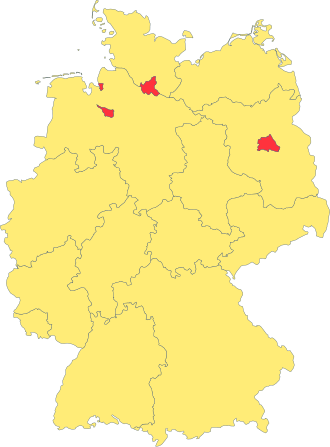
Germany is a federation comprising sixteen constituent states referred to as Länder,[136] thirteen of which are so-called “area-states” (Flächenländer). Two states, Berlin and Hamburg, are city-states (Stadtstaaten), in which there is no separation between state government and local administration. The state of Bremen, though officially also called a Stadtstaat, consists of the cities of Bremen, for which the state government also serves as the municipal administration, and the exclave of Bremerhaven.[137]
Each state (Land) has its own constitution[138] and is largely autonomous in its organisation.[136] As of 2017, Germany is divided into 401 districts (Kreise) at a municipal level; these consist of 294 rural districts and 107 urban districts.[139]
| State | Capital | Area[140] | Population (census 2022)[6] | Nominal GDP[141] | Nominal GDP per capita EUR (2023)[142] | ||
|---|---|---|---|---|---|---|---|
| km2 | mi2 | Billions EUR (2023) | Share of GDP (%) | ||||
| Baden-Württemberg | Stuttgart | 35,751 | 13,804 | 11,104,040 | 615.071 | 14.92 | 54,339 |
| Bavaria | Munich | 70,550 | 27,240 | 13,038,724 | 768.469 | 18.65 | 57,343 |
| Berlin | Berlin | 892 | 344 | 3,596,999 | 193.219 | 4.69 | 51,209 |
| Brandenburg | Potsdam | 29,654 | 11,449 | 2,534,075 | 97.477 | 2.37 | 37,814 |
| Bremen | Bremen | 420 | 162 | 693,204 | 39.252 | 0.95 | 56,981 |
| Hamburg | Hamburg | 755 | 292 | 1,808,846 | 150.575 | 3.65 | 79,176 |
| Hesse | Wiesbaden | 21,115 | 8,153 | 6,207,278 | 351.139 | 8.52 | 54,806 |
| Mecklenburg-Vorpommern | Schwerin | 23,214 | 8,963 | 1,570,817 | 59.217 | 1.44 | 36,335 |
| Lower Saxony | Hanover | 47,593 | 18,376 | 7,943,265 | 363.109 | 8.81 | 44,531 |
| North Rhine-Westphalia | Düsseldorf | 34,113 | 13,171 | 17,890,489 | 839.084 | 20.36 | 46,194 |
| Rhineland-Palatinate | Mainz | 19,854 | 7,666 | 4,094,169 | 174.249 | 4.23 | 41,797 |
| Saarland | Saarbrücken | 2,569 | 992 | 1,006,864 | 41.348 | 1.00 | 41,617 |
| Saxony | Dresden | 18,416 | 7,110 | 4,038,131 | 155.982 | 3.78 | 38,143 |
| Saxony-Anhalt | Magdeburg | 20,452 | 7,897 | 2,146,443 | 78.38 | 1.90 | 35,911 |
| Schleswig-Holstein | Kiel | 15,802 | 6,101 | 2,927,542 | 118.68 | 2.88 | 40,090 |
| Thuringia | Erfurt | 16,202 | 6,256 | 2,110,396 | 75.909 | 1.84 | 35,715 |
| Germany | Berlin | 357,386 | 137,988 | 82,719,540 | 4,121.16 | 100 | 48,750 |
Economy
Main article: Economy of Germany
See also: Science and technology in Germany and List of German inventions and discoveries
.jpg "Study in Germany")
Germany has a social market economy with a highly skilled labour force, a low level of corruption,[178] and a high level of innovation.[179] It is the largest economy in Europe by nominal GDP, as well as the world’s third-largest by nominal GDP[180] and sixth-largest by PPP-adjusted GDP.[181] Its PPP-adjusted GDP per capita amounted to 115% of the EU average in 2024.[182] The country’s service sector contributes approximately 72% of the total GDP, the industrial sector 27%—with Germany having the largest manufacturing output in Europe—and its agricultural sector 1%, as of 2023.[113] The unemployment rate published by Eurostat amounts to 3.2% as of January 2020, which is the fourth-lowest in the EU.[183]
Germany is part of the European single market which represents more than 450 million consumers.[184] In 2017, the country accounted for 28% of the eurozone economy according to the International Monetary Fund.[185] Germany introduced the common EU currency, the euro, in 2002.[186] Its monetary policy is set by the European Central Bank,[187] which is based in Frankfurt, the country’s largest financial centre.[188] Germany is the world’s third-largest exporter and third-largest importer,[113] and it has the second-largest trade surplus after China. Its largest trading partners in 2025 were China, the United States and the Netherlands.[189] Germany’s main exports are vehicles, machinery, and chemical goods.[190]
The German automotive industry is among the most competitive and innovative in the world.[191] It was the sixth-largest by production and largest by export value in 2023.[192] Germany is home to Volkswagen Group, the world’s second-largest automotive manufacturer by vehicle production.[193]
Of the world’s 500 largest stock market-listed companies by revenue in 2024, the Fortune Global 500, 29 were based in Germany.[194] The DAX, Germany’s stock market index operated by the Frankfurt Stock Exchange, includes 30 major Germany-based companies.[195] Prominent German companies include Mercedes-Benz, BMW, Volkswagen, Audi, Porsche, Siemens, Adidas, SAP, Bosch and BASF. Berlin is a hub for startup companies and has become the leading location for venture capital-funded firms in the EU.[196] Germany is recognised for its large portion of specialised small and medium enterprises known as the Mittelstand;[197] these companies represent around 48% of the global market leaders in their segments, labelled hidden champions.[198]
Research and development efforts form an integral part of the German economy,[199] with the country ranking fourth in research and development expenditure since 2005.[200] In 2018, Germany ranked fourth globally in terms of number of science and engineering research papers published[201] and third in the quality-adjusted Nature Index in 2023.[202] Well-known research institutions in Germany include the Max Planck Society, the Helmholtz Association, the Fraunhofer Society, and the Leibniz Association.[203] Germany is the largest contributor to the European Space Agency.[204] The country was ranked 11th in the Global Innovation Index in 2025.[205]
Infrastructure
Main articles: Transport in Germany, Energy in Germany, Telecommunications in Germany, and Water supply and sanitation in Germany

With its central position in Europe, Germany is a transport hub for the continent.[206] Its road network is among the densest in Europe.[207] The motorway (Autobahn) is widely known for having no general federally mandated speed limit for some classes of vehicles.[208] The Intercity Express or ICE train network serves major German cities as well as destinations in neighbouring countries with speeds up to 300 km/h (190 mph).[209] The largest German airports are Frankfurt Airport, Munich Airport and Berlin Brandenburg Airport.[210] The Port of Hamburg is the third-busiest port in Europe and one of the twenty largest container ports in the world.[211]
In 2019, Germany was the world’s seventh-largest consumer of energy.[212] All German nuclear power plants were phased out in 2023.[213] Germany meets its power demands using 40% renewable sources (2018),[214] and has been called an “early leader” in solar panels and offshore wind.[215] The German energy transition (Energiewende) is the recognised move to a sustainable economy by means of energy efficiency and renewable energy,[216][217] with the country being called “the world’s first major renewable energy economy”.[218] Germany has reduced its primary energy consumption by 11% between 1990 and 2015[219] and set itself goals of reducing it by 30% until 2030 and 50% by 2050.[220]
The country is committed to the Paris Agreement and several other treaties promoting biodiversity,[221] low emission standards,[222] and water management.[223] As of 2017, Germany’s household recycling rate is among the highest in the world, at around 65%.[224] In 2023, Germany was the 14th highest emitting nation of greenhouse gases.[225]
Tourism
Main article: Tourism in Germany

Domestic and international travel and tourism directly contributed over €105.3 billion to German GDP in 2015.[226] Including indirect and induced impacts, the industry supported nearly 4.2 million jobs in 2015.[226] As of 2024, Germany is the seventh-most-visited country.[227] Its most popular landmarks include Cologne Cathedral, the Brandenburg Gate, the Reichstag, the Dresden Frauenkirche, Neuschwanstein Castle, Heidelberg Castle, the Wartburg, and Sanssouci Palace.[228] Europa-Park near Freiburg is Europe’s second-most popular theme park resort.[229]
Demographics
Main article: Demographics of Germany
See also: Germans
With a population of 84.7 million according to the 2023 German census,[230] Germany is the most populous member state of the European Union, the second-most populous country in Europe[f] after Russia,[113] and the nineteenth-most populous country in the world. Its population density stands at 236 inhabitants per square kilometre (610 inhabitants/mi2). The fertility rate of 1.57 children born per woman (2022 estimates) is below the replacement rate of 2.1 and is one of the lowest in the world.[113] Since the 1970s, Germany’s death rate has exceeded its birth rate. However, the country is witnessing increased birth and migration rates since the early 2010s. Germany has the fourth oldest population in the world, with an average age of 47.8 years.[113]

Four sizeable groups of people are referred to as national minorities because their ancestors have lived in their respective regions for centuries:[232] There is a Danish minority in the northernmost state of Schleswig-Holstein;[232] the Sorbs, a Slavic population, are in the Lusatia region of Saxony and Brandenburg; the Roma and Sinti live throughout the country; and the Frisians are concentrated in Schleswig-Holstein’s western coast and in the north-western part of Lower Saxony.[232]
Germany is a major destination for immigrants, ranking second in the world after the United States.[233] In 2015, following the 2015 refugee crisis, the Population Division of the United Nations Department of Economic and Social Affairs listed Germany as host to the second-highest number of international migrants worldwide, about 5% or 12 million of all 244 million migrants.[234] Refugee crises have resulted in substantial population increases;[235] for example, the major influx of Ukrainian immigrants following the 2022 Russian invasion of Ukraine, whereby over 1.06 million refugees from Ukraine were recorded in Germany as of April 2023.[236] In 2019, Germany ranked seventh among EU countries in terms of the percentage of migrants in the country’s population, at 13.1%.[237] In 2022, there were 23.8 million people—28.7 percent of the total population—who had a migration background.[238]
Germany has over 2,000 cities and towns, and 11 officially recognised metropolitan regions. The country’s most populous city is Berlin, and its largest urban area is the Ruhr.[239]
| vteLargest cities or towns in Germany Federal Statistical Office of Germany – Destatis (census 2022)[240] | |||||||||
|---|---|---|---|---|---|---|---|---|---|
| Rank | Name | State | Pop. | Rank | Name | State | Pop. | ||
| 1 | Berlin | Berlin | 3,685,265 | 11 | Essen | North Rhine-Westphalia | 571,039 | ||
| 2 | Hamburg | Hamburg | 1,862,565 | 12 | Dresden | Saxony | 557,782 | ||
| 3 | Munich | Bavaria | 1,478,638 | 13 | Nuremberg | Bavaria | 522,554 | ||
| 4 | Cologne | North Rhine-Westphalia | 1,017,355 | 14 | Hanover | Lower Saxony | 513,291 | ||
| 5 | Frankfurt | Hesse | 743,268 | 15 | Duisburg | North Rhine-Westphalia | 501,415 | ||
| 6 | Düsseldorf | North Rhine-Westphalia | 611,258 | 16 | Wuppertal | North Rhine-Westphalia | 356,768 | ||
| 7 | Stuttgart | Baden-Württemberg | 610,458 | 17 | Bochum | North Rhine-Westphalia | 354,288 | ||
| 8 | Leipzig | Saxony | 598,899 | 18 | Bielefeld | North Rhine-Westphalia | 330,072 | ||
| 9 | Dortmund | North Rhine-Westphalia | 598,246 | 19 | Bonn | North Rhine-Westphalia | 321,544 | ||
| 10 | Bremen | Bremen | 575,071 | 20 | Mannheim | Baden-Württemberg | 313,693 | ||
Languages
Main article: Languages of Germany
See also: German language

German is the official and predominantly spoken language in Germany.[241] It is one of 24 official and working languages of the European Union, and one of the three procedural languages of the European Commission, alongside English and French.[242] German is the most widely spoken first language in the European Union, with around 100 million native speakers.[243]
Recognised native minority languages in Germany are Danish, Low German, Low Rhenish, Sorbian, Romani, North Frisian and Saterland Frisian; they are officially protected by the European Charter for Regional or Minority Languages. The most used immigrant languages are Turkish, Arabic, Kurdish, Polish, Italian, Greek, Spanish, Serbo-Croatian, Bulgarian and other Balkan languages, as well as Russian. Germans are typically multilingual: 74% of German citizens claim to be able to communicate in at least one foreign language and 35% in at least two.[244]
Religion
Main article: Religion in Germany
Further information: Catholic Church in Germany, Evangelical Church in Germany, History of the Jews in Germany, and Islam in Germany
.jpg "Study in Germany")
According to the 2022 census, Christianity is the largest religion in Germany at 49.7% of the population; 23.1% identified as Protestant and 25.1% as Catholic.[245]
A study in 2023 estimated that 46.2% of the population are not members of any religious organisation or denomination and that a majority of the population no longer belongs to a Christian denomination (48.5% Christians).[246] Irreligion in Germany is strongest in major metropolitan areas and throughout the former East Germany, which used to be predominantly Protestant before the imposition of state atheism under communism.[247][248]
Islam is the second-largest religion in the country.[249] In the 2011 census, 1.9% of respondents (1.52 million people) gave their religion as Islam, but this figure is deemed unreliable because a disproportionate number of adherents of this faith (and other religions, such as Judaism) are likely to have made use of their right not to answer the question.[250] In 2019, there were an estimated 5.3–5.6 million Muslims with a migrant background[g] (6.4–6.7% of the population), in addition to an unknown number of Muslims without a migrant background.[251] Most of the Muslims are Sunnis and Alevis from Turkey, but there are a small number of Shi’ites, Ahmadiyyas and other denominations. Other religions each comprise less than one percent of Germany’s population.[249]
In 2011, formal members of the Jewish community represented no more than 0.2% of the total German population, and 60% of them resided in Berlin.[252] An estimated 80 to 90 percent of these Jews in Germany are Russian-speaking immigrants from the former Soviet Union who came to Germany from the 1980s onwards.[253][254]
Education
Main article: Education in Germany

Responsibility for educational supervision in Germany is primarily organised within the individual states. Optional kindergarten education is provided for all children between three and six years old, after which school attendance is compulsory for at least nine years depending on the state. Primary education usually lasts for four to six years.[255] Secondary schooling is divided into tracks based on whether students pursue academic or vocational education.[256] A system of apprenticeship called Duale Ausbildung leads to a skilled qualification which is almost comparable to an academic degree. It allows students in vocational training to learn in a company as well as in a state-run trade school.[255] This model is well regarded and reproduced all around the world.[257]
Most of the German universities are public institutions, and students traditionally study without fee payment.[258] The general requirement for attending university is the Abitur. According to an OECD report from 2014, Germany is the world’s third leading destination for international study.[259] The established universities in Germany include some of the oldest in the world, with Heidelberg University (established in 1386), Leipzig University (established in 1409) and the University of Rostock (established in 1419) being the oldest in the country.[260] The Humboldt University of Berlin, founded in 1810 by the liberal educational reformer Wilhelm von Humboldt, became the academic model for many Western universities.[261][262]
Health
Main article: Health in Germany
Further information: Healthcare in Germany
.jpg "Study in Germany")
Germany’s system of hospitals, called Krankenhäuser, dates from medieval times, and the country has the world’s oldest universal health care system, dating from Bismarck’s social legislation of the 1880s.[264] Since the 1880s, reforms and provisions have ensured a balanced health care system. The population is covered by a health insurance plan provided by statute, with criteria allowing some groups to opt for a private health insurance contract. According to the World Health Organization (WHO), Germany’s health care system was 77% government-funded and 23% privately funded in 2013.[265] In 2024, Germany spent 12.27% of its GDP on health care.[266]
Germany ranked 21st in the world in 2019 in life expectancy with 78.7 years for men and 84.8 years for women according to the WHO, and it had a very low infant mortality rate of 4 deaths per 1,000 live births. In 2019, the principal cause of death was cardiovascular disease, at 37%.[267] Obesity in Germany has been increasingly cited as a major health issue: a 2014 study showed that 52 percent of the adult German population was overweight or obese.[268]
Germany has an extensive psychiatric care system, with rising demand for mental health services; roughly 27.8% of adults experience a mental disorder annually.[269][270] While the system offers comprehensive, insurance-covered care, it faces a shortage of psychotherapists and a pandemic-driven surge in anxiety and depression.[271] In 2023, 37.7% of adults rated their mental health as excellent or very good.[272] Germany had the third-highest rate of chronic depression among EU countries in 2019.[273]
Culture
Main article: Culture of Germany

Culture in German states has been shaped by major intellectual and popular currents in Europe, both religious and secular, and German scientists, writers and philosophers have played a significant role in the development of Western thought.[274] Global opinion polls from the BBC revealed that Germany is recognised for having the most positive influence in the world in 2013[275] and 2014.[276]
Germany is well known for such folk festivals as the Oktoberfest[277] and Christmas customs, which include Advent wreaths, Christmas pageants, Christmas trees, Stollen cakes, and other practices.[278] As of 2025, UNESCO inscribed 55 properties in Germany on the World Heritage List.[279] There are a number of public holidays in Germany determined by each state; 3 October has been a national day of Germany since 1990, celebrated as the Tag der Deutschen Einheit (German Unity Day).[280]
Art, design and architecture
Main articles: German art, Architecture of Germany, and German fashion

C.D. Friedrich, Wanderer above the Sea of Fog (1818)

Franz Marc, Roe Deer in the Forest (1914)
German painters have influenced Western art. Albrecht Dürer, Hans Holbein the Younger, Matthias Grünewald and Lucas Cranach the Elder were important German artists of the Renaissance, Johann Baptist Zimmermann of the Baroque, Caspar David Friedrich and Carl Spitzweg of Romanticism, Max Liebermann of Impressionism and Max Ernst of Surrealism. Several German art groups formed in the 20th century; Die Brücke (The Bridge) and Der Blaue Reiter (The Blue Rider) influenced the development of expressionism in Munich and Berlin. The New Objectivity arose in response to expressionism during the Weimar Republic. After World War II, broad trends in German art include neo-expressionism and the New Leipzig School.[281]
German designers became early leaders of modern product design.[282] The Berlin Fashion Week and the fashion trade fair Bread & Butter are held twice a year.[283]
Architectural contributions from Germany include the Carolingian and Ottonian styles, which were precursors of Romanesque. Brick Gothic is a distinctive medieval style that evolved in Germany. Also in Renaissance and Baroque art, regional and typically German elements evolved (e.g. Weser Renaissance).[281] Vernacular architecture in Germany is often identified by its timber framing (Fachwerk) traditions and varies across regions, and among carpentry styles.[284] When industrialisation spread across Europe, classicism and a distinctive style of historicism developed in Germany, sometimes referred to as Gründerzeit style. Expressionist architecture developed in the 1910s in Germany and influenced Art Deco and other modern styles. Germany was particularly important in the early modernist movement: it is the home of Werkbund initiated by Hermann Muthesius (New Objectivity), and of the Bauhaus movement founded by Walter Gropius.[281] Ludwig Mies van der Rohe became one of the world’s most renowned architects in the second half of the 20th century; he conceived of the glass façade skyscraper.[285] Renowned contemporary German architects and offices include Pritzker Prize winners Gottfried Böhm and Frei Otto.[286]
Literature and philosophy
Main articles: German literature and German philosophy

German literature can be traced back to the Middle Ages and the works of writers such as Walther von der Vogelweide and Wolfram von Eschenbach. Well-known German authors include Johann Wolfgang von Goethe, Friedrich Schiller, Gotthold Ephraim Lessing and Theodor Fontane. The collections of folk tales published by the Brothers Grimm popularised German folklore on an international level.[287] The Grimms also gathered and codified regional variants of the German language, grounding their work in historical principles; their Deutsches Wörterbuch, or German Dictionary, sometimes called the Grimm dictionary, was begun in 1838 and the first volumes published in 1854.[288]
Influential authors of the 20th century include Gerhart Hauptmann, Thomas Mann, Hermann Hesse, Heinrich Böll, and Günter Grass.[289] The German book market is the third-largest in the world, after the United States and China.[290] The Frankfurt Book Fair is the most important in the world for international deals and trading, with a tradition spanning over 500 years.[291] The Leipzig Book Fair also retains a major position in Europe.[292]
German philosophy is historically significant: Gottfried Leibniz‘s contributions to rationalism; the enlightenment philosophy by Immanuel Kant; the establishment of classical German idealism by Johann Gottlieb Fichte, Georg Wilhelm Friedrich Hegel and Friedrich Wilhelm Joseph Schelling; Arthur Schopenhauer‘s composition of metaphysical pessimism; the formulation of communist theory by Karl Marx and Friedrich Engels; Friedrich Nietzsche‘s development of perspectivism; Gottlob Frege‘s contributions to the dawn of analytic philosophy; Martin Heidegger‘s works on Being; Oswald Spengler‘s historical philosophy; and the development of the Frankfurt School have all been very influential.[293]
Music
Main article: Music of Germany
See also: Opera in German

German classical music includes works by some of the world’s most well-known composers. Dieterich Buxtehude, Johann Sebastian Bach and Georg Friedrich Händel were influential composers of the Baroque period. Ludwig van Beethoven was a crucial figure in the transition between the Classical and Romantic eras. Carl Maria von Weber, Felix Mendelssohn, Robert Schumann and Johannes Brahms were significant Romantic composers. Richard Wagner was known for his operas. Richard Strauss was a leading composer of the late Romantic and early modern eras. Karlheinz Stockhausen and Wolfgang Rihm are important composers of the 20th and early 21st centuries.[294]
In 2013, Germany was the second-largest music market in Europe, and fourth-largest in the world.[295] German popular music of the 20th and 21st centuries includes the movements of Neue Deutsche Welle, pop, Ostrock, heavy metal/rock, punk, pop rock, indie, Volksmusik (folk music), schlager pop and German hip hop. German electronic music gained global influence, with Kraftwerk and Tangerine Dream pioneering in this genre.[296] DJs and artists of the techno and house music scenes of Germany have become well known (e.g. Paul van Dyk, Felix Jaehn, Paul Kalkbrenner, Robin Schulz and Scooter).[297]
Media
Main article: Media of Germany
Further information: Cinema of Germany

The largest internationally operating media companies in Germany are Bertelsmann, Axel Springer SE and ProSiebenSat.1 Media. Germany’s television market is the largest in Europe, with over 38 million TV households as of 2012.[298] Around 90% of German households have cable or satellite TV, with a variety of free-to-view public and commercial channels.[299] There are more than 300 public and private radio stations in Germany; Germany’s national radio network is the Deutschlandradio, while the public Deutsche Welle is the main radio and television broadcaster in foreign languages.[299] Germany’s print media market is the largest in Europe.[299] The German newspapers with the highest circulation are Bild, Süddeutsche Zeitung, Frankfurter Allgemeine Zeitung and Die Welt.[299] The largest German magazines include ADAC Motorwelt and Der Spiegel.[299] Germany has a large video gaming market, with over 34 million players nationwide.[300] The annual Gamescom held in Cologne is the world’s largest gaming convention.[301]
German cinema has made major technical and artistic contributions to film. The first works of the Skladanowsky Brothers were shown to an audience in 1895. The renowned Babelsberg Studio in Potsdam was established in 1912, thus being the first large-scale film studio in the world. Early German cinema was particularly influential with German expressionists such as Robert Wiene and Friedrich Wilhelm Murnau. Director Fritz Lang‘s Metropolis (1927) is referred to as the first major science-fiction film. After 1945, many of the films of the immediate post-war period can be characterised as Trümmerfilm (rubble film). East German film was dominated by the state-owned film studio DEFA, while the dominant genre in West Germany was the Heimatfilm (“homeland film”).[302] The Academy Award for Best Foreign Language Film (“Oscar”) went to the German production The Tin Drum (Die Blechtrommel) in 1979, to Nowhere in Africa (Nirgendwo in Afrika) in 2002, and to The Lives of Others (Das Leben der Anderen) in 2007. Various Germans won an Oscar for their performances in films. The annual European Film Awards ceremony is held every other year in Berlin, home of the European Film Academy. The Berlin International Film Festival known as “Berlinale”, awarding the “Golden Bear” and held annually since 1951, is one of the world’s leading film festivals. The “Lolas” are annually awarded in Berlin, at the German Film Awards.[303]
Cuisine
Main article: German cuisine

Bread is a significant part of German cuisine, with German bakeries producing about 600 main types of bread and 1,200 types of pastries and rolls (Brötchen).[304] German cheeses account for about 22% of all cheese produced in Europe.[305] Germans produce their ubiquitous sausages in almost 1,500 varieties, including Bratwurst and Weißwurst.[306]
The national alcoholic drink is beer.[307] Germany’s beer consumption per capita stood at 110 litres (24 imp gal; 29 US gal) in 2013 and remains among the highest in the world.[308] German beer purity regulations date back to the 16th century.[309] Wine has become popular in many parts of the country, especially near the German wine regions.[310] In 2019, Germany was the ninth-largest wine producer in the world.[311]
The 2018 Michelin Guide awarded eleven restaurants in Germany three stars, giving the country a cumulative total of 300 stars.[312]
Sports
Main article: Sport in Germany

Football is the most popular sport in Germany. With more than 7 million official members, the German Football Association (Deutscher Fußball-Bund) is the largest single-sport organisation worldwide,[313] and the German top league, the Bundesliga, attracts the second-highest average attendance of all professional sports leagues in the world.[314] The German men’s national football team won the FIFA World Cup in 1954, 1974, 1990, and 2014,[315] the UEFA European Championship in 1972, 1980 and 1996,[316] and the FIFA Confederations Cup in 2017.[317]
Germany is one of the world’s leading motor sports countries, with constructors such as BMW and Mercedes playing prominent roles in international competition. Porsche has won the 24 Hours of Le Mans race 19 times, and Audi 13 times, as of April 2024.[318] The driver Michael Schumacher has set many motor sport records, having won seven Formula One World Drivers’ Championships.[319] Sebastian Vettel is also among the most successful Formula One drivers of all time.[320]
German athletes historically have been successful contenders in the Olympic Games, ranking third in an all-time Olympic Games medal count when combining East and West German medals prior to German reunification.[321] In 1936, Berlin hosted the Summer Games and the Winter Games in Garmisch-Partenkirchen.[322] Munich hosted the Summer Games of 1972.[323]