
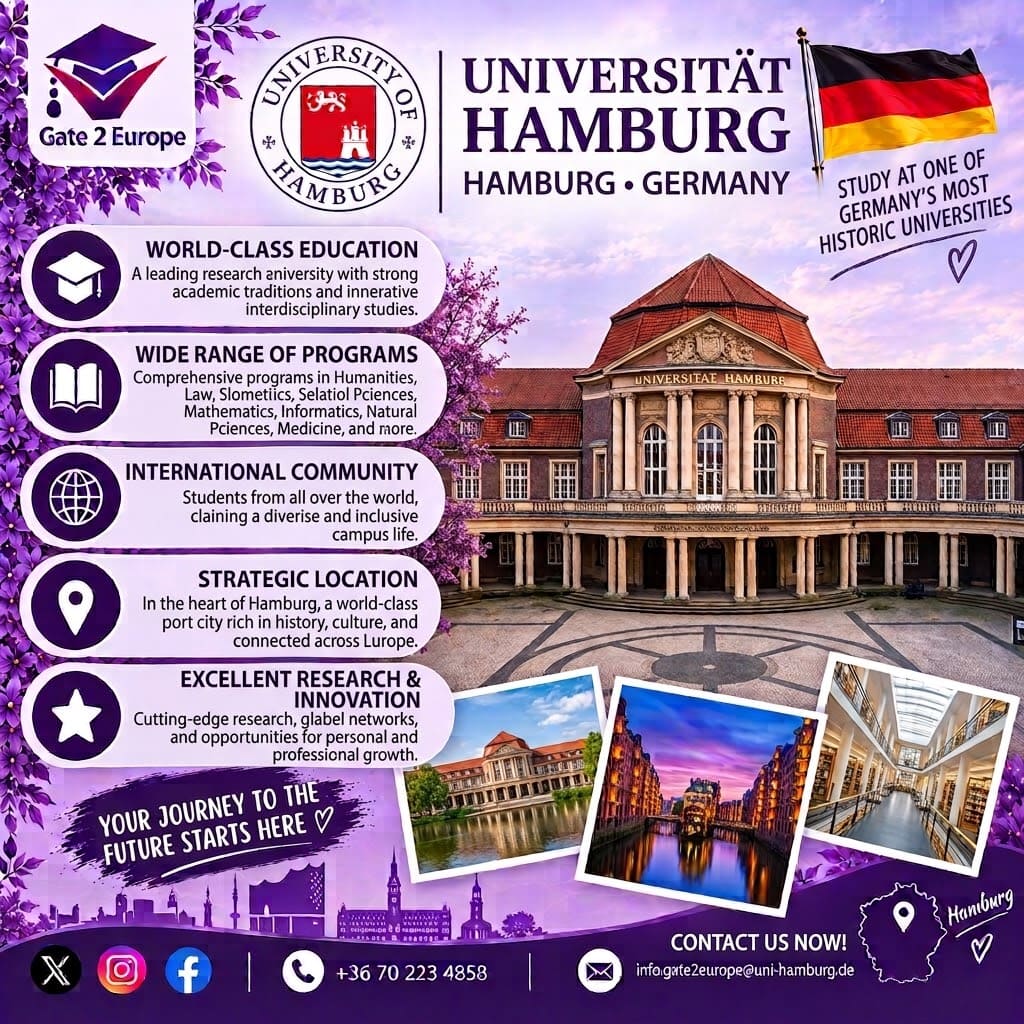
Hamburg University-Hamburg, Germany
The University of Hamburg (Universität Hamburg) is one of Northern Germany’s oldest and largest academic and research institutions. Since its establishment, the university has embodied a unique model of higher education through its independent ethos and complete integration with the city and its historic port, culminating in its status as a designated “University of Excellence” under Germany’s Excellence Strategy.
1. Introduction and Unique Origins
The First Democratic University: Officially founded in 1919 during the Weimar Republic, it became the first university in Germany established by a democratically elected parliament rather than by royal or religious decree.
Deeper Historical Roots: Its intellectual ancestry traces back to the Akademisches Gymnasium, established in 1613.
Motto: “To research, to teach, to educate” (Der Forschung, der Lehre, der Bildung).
2. Academic Standing and Innovation
University of Excellence: Awarded this prestigious German government title due to its cutting-edge affiliated research centers, particularly in Earth systems and climate science, astrophysics, and molecular imaging.
Nobel Laureates: Associated with 7 Nobel Prize winners, including astronomer Otto Stern, physicist Wolfgang Pauli, and most recently, Klaus Hasselmann for his work on climate modeling in 2021.
3. Location and Urban Campus
Located in the heart of Hamburg—Germany’s second-largest city and a major European economic and cultural hub—the university features a distinct infrastructure:
Open Urban Campus: Rather than an isolated campus layout, its buildings and faculties are integrated into vibrant neighborhoods such as Rotherbaum, Eimsbüttel, and Bahrenfeld.
Convenient Transit: The main facilities are situated near the central railway station and the Dammtor station, allowing quick and efficient transit via the public transport network (S-Bahn / U-Bahn).
Research Ecosystem Integration: The Bahrenfeld campus hosts advanced research facilities in collaboration with the German Electron Synchrotron (DESY), offering science and physics students direct access to a world-class research environment.
4. Key Features for International Students
Welcoming thousands of international students each year, the university provides a supportive environment designed for academic success and social integration:
Cultural Diversity: Home to over 43,000 students, with international students making up approximately 12% of the population from over 130 countries.
International Office Services (Department of International Affairs):
Academic and administrative advisory support prior to and upon arrival.
Orientation programs for new students.
Specialized workshops focused on academic writing and research methodology in German and English.
Scholarships and Financial Support:
Degree Completion Scholarships: Merit-based funding designated for international students in the final stages of their studies.
No Tuition Fees: Like most public universities in Germany, it charges no tuition fees; students pay only a seasonal administrative contribution (Semesterbeitrag), which covers a public transportation ticket and student services.
Employment Opportunities: As a major commercial, media, and logistical hub, the city of Hamburg provides ample student employment opportunities (Werkstudent) and internships across corporate, cultural, and research sectors.
5. Academic Structure and Degree Programs
The university comprises 8 main faculties offering a broad spectrum of degree programs:
Bachelor’s Degrees
Typically spanning 3 years (6 semesters), most undergraduate programs are taught in German (requiring B2 or C1 proficiency depending on the specialization), alongside select joint and language-focused programs.
Humanities and Languages: Languages and Literatures, Asian and African Studies, History, and Art History/Heritage Conservation.
Social Sciences and Economics: Political Science, Sociology, Business Administration (BWL), Economics (VWL), and Psychology.
Natural Sciences and Technology: Computer Science (Informatik), Physics, Chemistry, Biological Sciences, and Earth/Climate Sciences.
Education: Teacher training programs for various school levels.
Master’s Degrees
Lasting 2 years (4 semesters), the university offers an extensive selection of internationally oriented, English-taught Master’s programs:
Climate and Environmental Sciences: Integrated Climate System Sciences (ICSS)—a renowned international program affiliated with the CLICCS Cluster of Excellence.
Advanced Physics: M.Sc. Physics, conducted in collaboration with DESY and photon/quantum research centers.
Asian/African Studies and Heritage: Programs such as Manuscript Cultures and South Asian Studies.
Economics and Business: M.Sc. Economics and specialized international business management programs.
Tropical and Marine Biology: Tailored to Hamburg’s maritime location and riverine ecosystems.
Doctoral Studies & PhD Research
A global destination for researchers, driven by advanced infrastructure and dedicated Clusters of Excellence:
Doctoral Tracks:
Individual Doctorate: Flexible research conducted under the supervision of a primary advisor (Doktorvater/Doktermutter).
Structured PhD Programs: Enrollment in graduate schools providing structured coursework, group supervision, and dedicated funding.
Key Research Clusters (Clusters of Excellence):
CUI (Advanced Imaging of Matter): Imaging atomic and molecular dynamics.
CLICCS: Climate change research and societal transformations.
Quantum Universe: Astrophysics, cosmology, and dark matter particle physics.
Understanding Written Artefacts: Interdisciplinary study of historical manuscripts and written heritage across global cultures.
Conclusion
The University of Hamburg combines historical tradition with continuous academic evolution. Supported by its location in one of Germany’s top cities for quality of life, a robust research infrastructure, and comprehensive services for international scholars, it remains a premier destination for higher education and advanced research.
Useful Links: