
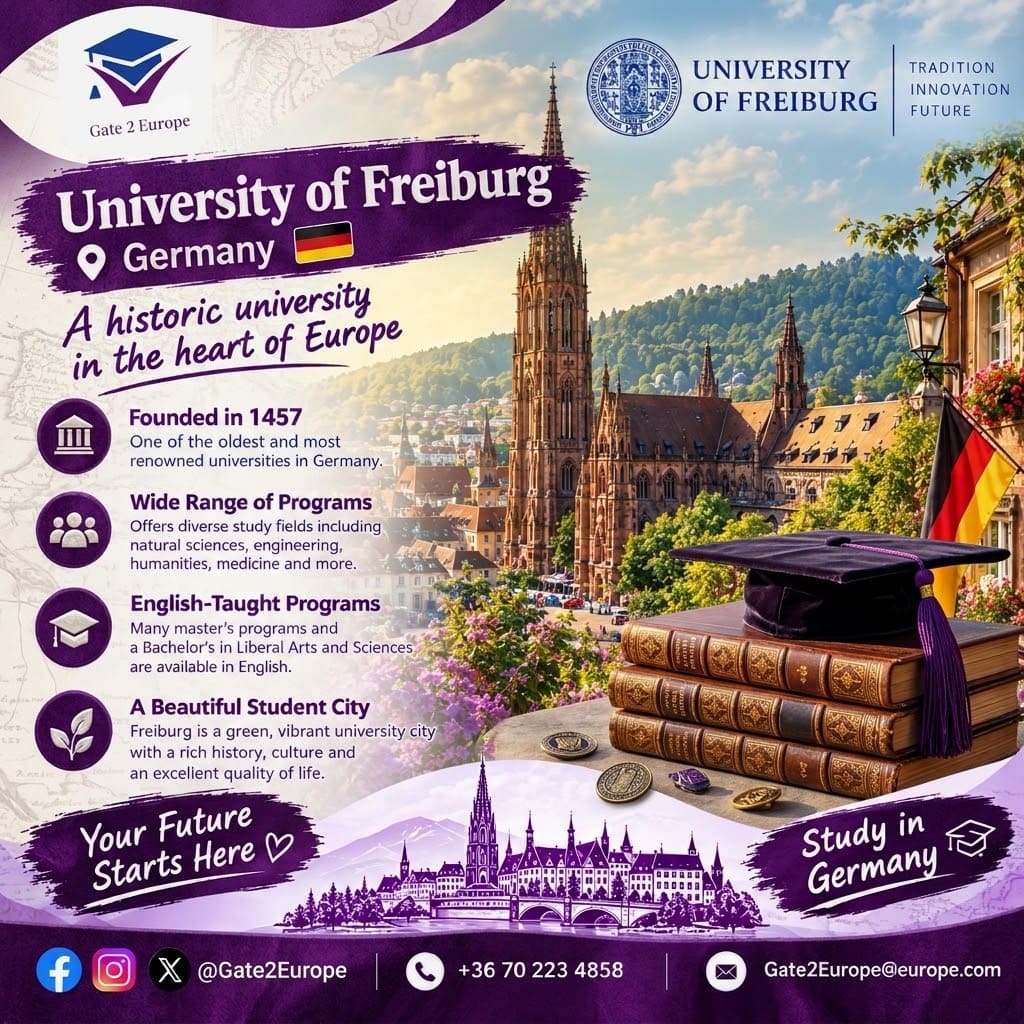
University of Freiburg-Freiburg im Breisgau,Germany
The University of Freiburg (Albert-Ludwigs-Universität Freiburg) is one of the oldest and most prestigious research universities in Germany and all of Europe.
1. Location, Establishment, and History
Location: The University of Freiburg is located in the city of Freiburg im Breisgau, in the state of Baden-Württemberg, southwestern Germany. It lies near the borders with France and Switzerland, within the famous Black Forest region.
Date of Foundation: Founded in 1457 by Archduke Albert VI, it is the fifth-oldest university in Germany.
Character: A traditional, historic university that is technologically advanced and fully integrated into the heart of the city. Its faculties, buildings, and libraries are spread across various neighborhoods of Freiburg.
2. Significance and Standing for International Students
The University of Freiburg hosts approximately 24,000 students, with international students comprising about 16% to 18% of the student body, hailing from more than 130 countries.
Key International Highlights:
University of Excellence: Awarded the status of “University of Excellence” in Germany over multiple funding rounds due to its strong research capacity.
Prestigious Global Rankings: Consistently ranks among the top 100–150 universities worldwide, and within the top 10 universities in Germany according to major international rankings such as QS and Times Higher Education (THE).
Nobel Laureate Heritage: Associated with more than 23 Nobel Laureates (including chemist Hermann Staudinger, economist Friedrich Hayek, and physicist Martin Martin, among others).
EUCOR Confederation (The European Campus): This partnership enables students to enroll in and take courses at neighboring universities such as Basel (Switzerland) and Strasbourg (France) with identical tuition and transportation conveniences.
Quality of Life and Climate: Known as the “Green Capital” and the sunniest city in Germany, Freiburg offers students an enjoyable, safe, and pleasant living experience.
3. Academic Programs (Bachelor’s, Master’s, PhD)
The University of Freiburg comprises 11 main faculties covering medicine, natural sciences, engineering, humanities, and social sciences.
A. Bachelor’s Degrees
Bachelor’s programs generally last 3 years (6 semesters) and lead to a B.Sc. or B.A. degree, alongside state examination (Staatsexamen) programs for medical and legal disciplines.
Language of Instruction: Most Bachelor’s programs are taught in German (requiring C1 proficiency in German).
Prominent Majors:
Engineering & Applied Sciences: Sustainable Systems Engineering, Computer Science, Biomedical Engineering.
Natural Sciences: Chemistry, Physics, Biology, Environmental Sciences, Earth Sciences, Pharmacy.
Medical & Health Sciences (Staatsexamen): Human Medicine, Dentistry (among the strongest faculties in Germany).
Humanities & Social Sciences: Law (Staatsexamen), Political Science, Economics, Philosophy, Psychology, History, Linguistics.
 Notable English-Taught Undergraduate Exception:
University of Freiburg offers the Liberal Arts and Sciences (LAS) program through University College Freiburg (UCF). This is a 4-year (240 ECTS) Bachelor’s program taught entirely in English, covering tracks in Governance, Applied Life Sciences, Culture & History, and Environmental Proficiency.
B. Master’s Degrees
Master’s programs generally take 2 years (4 semesters) to complete and rely on the European Credit Transfer and Accumulation System (120 ECTS). The university offers a broad range of programs, including over 20 Master’s degrees taught fully in English.
1. Key English-Taught Master’s Programs:
Engineering & Technology:
Computer Science (M.Sc.)
Embedded Systems Engineering (M.Sc.)
Sustainable Systems Engineering (M.Sc.)
Microsystems Engineering (M.Sc.)
Environmental & Forest Sciences:
Environmental Governance (MEG) – a world-renowned program
Forest Sciences / Renewable Energy Engineering & Management
Biological & Medical Sciences:
Neuroscience (M.Sc.)
Biomedical Sciences (M.Sc.) – in partnership with the University of Buenos Aires
Biochemistry and Biophysics (M.Sc.)
Humanities & Social Sciences:
Global Studies Programme (GSP) – an international joint degree
English Literatures and Literary Theory / Applied Linguistics
2. German-Taught Master’s Programs:
These cover all previously mentioned undergraduate disciplines with advanced, research-focused study options (e.g., Master’s in Clinical Psychology, Law LL.M., Chemistry, Physics, International Economics, and History).
C. Doctoral Studies (PhD)
The University of Freiburg enjoys an outstanding research reputation and offers two primary paths for completing a doctorate:
Individual Doctorate:
The student finds an academic supervisor (Professor) and agrees on a research project.
Offers high flexibility, and the working language is often English in scientific, engineering, and medical fields.
Structured PhD Programs / Graduate Schools:
Specialized graduate schools offering structured academic training along with seminars and research workshops.
Mostly run under the umbrella of the university’s centers of excellence (such as the Spemann Graduate School of Biology and Medicine – SGBM).
Admission is through periodic international competition, and these programs frequently include funding or research assistant contracts (TV-L).
4. Tuition, Costs, and General Requirements
Tuition Fees: The state of Baden-Württemberg charges tuition fees to non-EU/EEA international students amounting to €1,500 per semester (Note: text originally noted €1,500 per month / per semester).
Semester Contribution: In addition to tuition, a semester fee of approximately €150–€180 per semester is charged to cover administrative costs, student services, and public transport access.
Language Requirements:
For German-Taught Programs: C1 certificate (e.g., TestDaF with 4×4, DSH-2, or Goethe C1/C2).
For English-Taught Programs: IELTS (typically 6.5 to 7.0) or TOEFL iBT (80 to 100), depending on individual program requirements.
Important Links