
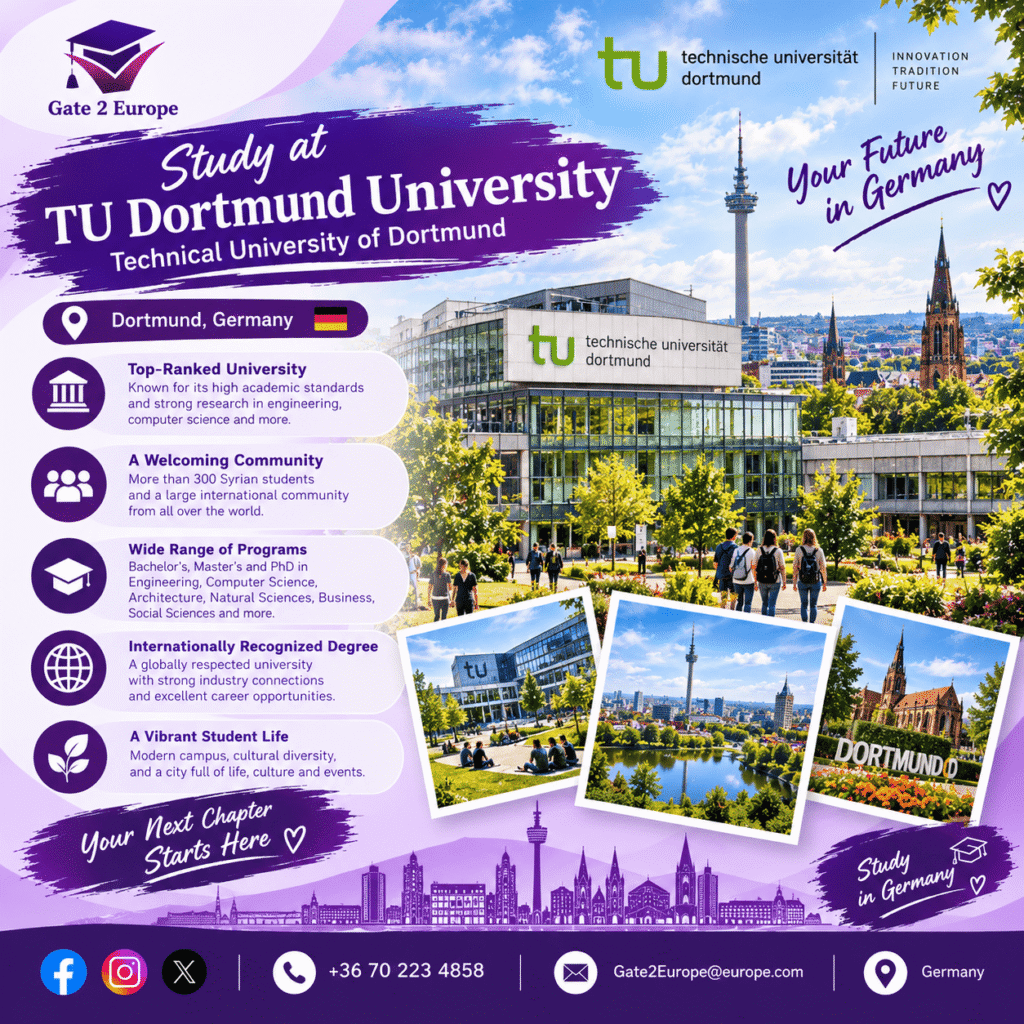
TU Dortmund University-Germany
1. Introduction and Historical Background
TU Dortmund University (Technische Universität Dortmund) is one of the youngest, fastest-growing, and most dynamically developing universities in the Federal Republic of Germany. Founded in 1968, the university emerged during a period of major structural and economic transformation in the state of North Rhine-Westphalia. During this era, the Ruhr Area shifted from an economy heavily dependent on coal and steel industries into an international hub for technology, science, and higher education.
Since its inception, the university has distinguished itself by bridging engineering and technological disciplines with natural sciences, humanities, and educational sciences. This interdisciplinary integration fosters a unique academic environment tailored for interdisciplinary research. Today, TU Dortmund University hosts over 32,000 students, including thousands of international students representing more than 100 countries worldwide.
2. Geographical Location and Campus Life
TU Dortmund University is located in Dortmund, the largest city in the Ruhr region and one of the most populous cities in the state. The city boasts a rich cultural and sports heritage and serves as a key node for the digital economy and innovation in Germany.
Campus Highlights
The university layout is split into two primary locations:
North Campus (Nordcampus): The primary and larger campus housing most engineering faculties, natural sciences, the central library, and administrative offices.
South Campus (Südcampus): Home to the faculties of spatial planning, social sciences, and various educational departments.
The H-Bahn (Automated Monorail): North and South campuses are seamlessly connected by the H-Bahn, an automated driverless suspended monorail. It stands as an iconic architectural and technological trademark of TU Dortmund University.
Cost of Living: Dortmund offers a moderate and student-friendly cost of living compared to major German cities like Munich or Frankfurt, making it an appealing option for international students.
3. Key Advantages for International Students
TU Dortmund University ranks prominently among modern global university rankings, providing an inclusive and supportive academic environment for international students:
Cultural Diversity and Integration: The university embraces a vibrant international student community and offers comprehensive orientation programs alongside academic guidance for newcomers.
International Office (Referat Internationales): Delivers end-to-end support, including academic advising, assistance with visa/residence permits, and cultural integration events.
Industry & Research Partnerships: Situated in an innovation hub alongside premier research institutions (such as Fraunhofer and Max Planck institutes) and industrial enterprises, the university offers extensive opportunities for internships and student employment.
Language and Preparatory Courses: TU Dortmund University offers intensive German language courses and preparatory training for students seeking to meet academic language requirements before beginning their degree programs.
4. Academic Programs
TU Dortmund University offers a wide array of academic degree programs across 16 distinct faculties, spanning Bachelor’s, Master’s, and Doctoral (Ph.D.) levels.
First: Bachelor’s Degrees
Bachelor’s degree programs typically span 6 to 7 semesters (3 to 3.5 years). Most undergraduate programs are taught in German (requiring a C1 level certificate such as TestDaF or DSH), though select modules and tracks are offered in English.
Key Disciplines:
Engineering & Technology:
Electrical Engineering & Information Technology
Mechanical Engineering
Chemical & Bio Engineering
Civil Engineering
Logistics Engineering (Dortmund is a globally recognized research hub in logistics)
Computer Science & Technology:
Computer Science
Data Science
Applied Data Science
Planning & Architecture:
Spatial Planning (one of the oldest and most prestigious programs in Germany)
Natural Sciences:
Physics / Medical Physics
Chemistry / Biochemistry
Mathematics & Statistics
Economics, Social & Educational Sciences:
Business Administration & Economics
Teacher Training Programs
Journalism and Media Studies
Second: Master’s Degrees
Master’s programs generally last 4 semesters (2 years). TU Dortmund University offers a variety of Master’s programs taught entirely in English alongside its German-taught degrees.
Prominent English-Taught Master’s Programs:
Automation and Robotics: A premier interdisciplinary program blending electrical, mechanical, and computer engineering.
Data Science: Jointly offered by the faculties of Statistics, Computer Science, and Mathematics.
Spatial Planning for Regions in Growing Economies (SPRING): A globally oriented program focusing on urban and regional planning in developing and emerging nations.
Chemical Biology: Focuses on advanced research at the intersection of chemistry and biological systems.
Econometrics: An advanced program offered in collaboration with neighboring universities in the Ruhr region.
German-Taught Master’s Programs:
M.Sc. in Mechanical Engineering, Electrical Engineering, and Chemical Engineering
M.Sc. in Business Administration, Applied Statistics, and Logistics Management
M.Sc. in Spatial Planning and Architectural Sciences
Third: Doctoral Studies & Ph.D. Research
Research is a central pillar at TU Dortmund University, offering ideal conditions for Ph.D. candidates and postdoctoral researchers.
Structured Ph.D. Programs: These programs enable researchers to collaborate within international teams while gaining academic and professional development.
Core Research Focus Areas:
Materials, Production Technology, and Logistics
Data Analysis, Modeling, and Simulation
Chemical Biology and Drug Research
Funding & Research Assistantships: Ph.D. candidates can obtain funding through university research assistant positions (Wissenschaftlicher Mitarbeiter) or external scholarships such as those funded by the DAAD (German Academic Exchange Service).
5. Admission Requirements and Application Process
Academic Certificates: Recognition of secondary school diplomas or prior undergraduate degrees via the German Anabin evaluation database.
Language Proficiency:
German-taught programs: DSH-2, TestDaF (4×4), or CEFR C1.
English-taught programs: IELTS (typically 6.5+) or TOEFL iBT (typically 80+).
Application Channels: Most international applications are processed either through the Uni-Assist portal or via the university’s direct application portal, depending on the applicant’s nationality and chosen field of study.
6. Conclusion
TU Dortmund University is more than an institution for higher learning; it is a thriving technological and academic community empowering international students to build successful careers in research and industry. With its interdisciplinary curriculum, strategic location, and supportive environment, TU Dortmund remains a top-tier destination for higher education in Europe.
Useful Links