
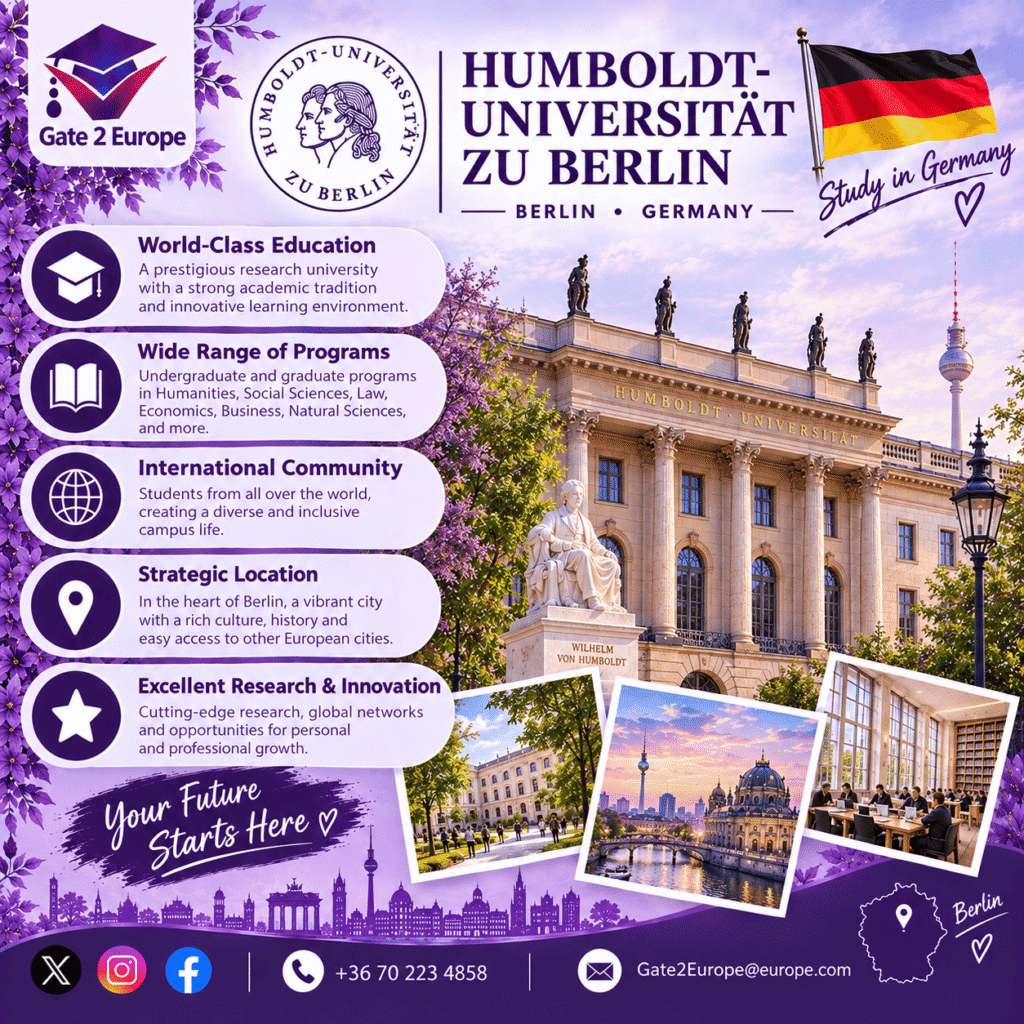
Humboldt University of Berlin (Humboldt-Universität zu Berlin)
Humboldt University of Berlin (Humboldt-Universität zu Berlin) is considered one of the most prestigious and influential educational institutions in modern history. It is not merely a degree-granting university, but the very cradle of the modern model of higher education—one built on the integration of scientific research and teaching, which has inspired leading universities around the globe.
Rich History and Foundational Vision
Founded in 1810 on the initiative of the German linguist and diplomat Wilhelm von Humboldt, alongside prominent thinkers of his era such as Johann Gottlieb Fichte and Friedrich Schleiermacher, the institution was initially named the “University of Berlin.” It was later renamed “Friedrich Wilhelm University” before settling on its current name, “Humboldt University,” in 1949 to honor its founder and his brother, the renowned scientist Alexander von Humboldt.
The university’s history is intertwined with major intellectual and scientific breakthroughs. Giants of human thought and science studied and taught here, including Albert Einstein, Max Planck, Karl Marx, Friedrich Engels, and the philosopher Georg Wilhelm Friedrich Hegel. Its heritage is also tied to more than 55 Nobel Laureates across various fields, cementing its status as an enduring global beacon of free inquiry and innovation.
Geographic Location and Campuses
Humboldt University’s faculties and institutes are spread across three main campuses throughout Berlin, offering students a vibrant experience that combines academic study with rich cultural life:
Campus Mitte: Located in the historic heart of Berlin on the famous Unter den Linden boulevard, the historic main building houses the faculties of Humanities, Arts, Philosophy, Law, Economics, and Social Sciences.
Campus Adlershof: Situated in southeastern Berlin, this is one of Europe’s largest science and technology parks. It hosts natural and applied science departments, including Physics, Chemistry, Mathematics, Computer Science, and Geography.
Campus Nord: Located near the city center, this campus accommodates Life Sciences, Veterinary Medicine, and Agricultural Sciences, alongside a unique medical partnership with the Free University of Berlin.
Significance for International Students and Academic Environment
Today, Humboldt University educates over 37,000 students, with international students from more than 100 countries accounting for roughly 18% to 20% of the student body, reflecting a diverse and multicultural atmosphere.
Key benefits for international students include:
Prestigious Academic Reputation: The university consistently ranks among the top institutions in Germany and globally in the QS and Times Higher Education rankings, particularly in Philosophy, Arts, and Social Sciences.
International Programs and Language Diversity: While most undergraduate courses are taught in German, the university offers a broad range of master’s and doctoral degree programs taught entirely in English.
Academic Support and Integration: The university’s International Office provides comprehensive services, including academic advising, assistance with residency procedures, intensive German language courses, and peer-mentoring programs.
Unique Medical Partnership: In collaboration with the Free University of Berlin, the university jointly manages the renowned Charité – Universitätsmedizin Berlin, one of Europe’s largest and most famous university hospitals.
Academic Disciplines and Degree Programs
Humboldt University comprises nine main faculties offering hundreds of academic degree programs across all tertiary levels.
1. Bachelor’s Degree
Bachelor’s programs typically last 3 years (6 semesters). Most are taught in German, requiring a C1 proficiency level (such as DSH-2 or TestDaF 4). Programs are structured as either single-major or dual-major (main subject combined with a minor) degrees.
Humanities and Arts: Philosophy, History, Languages and Literatures (German, English, French, Spanish, Arabic, and Islamic Studies), Archaeology, and Art History.
Social and Educational Sciences: Political Science, Sociology, Educational Sciences, and Area Studies (such as Asian and African Studies).
Law and Economics: Business Administration, Economics and Econometrics, and Legal Studies (leading to the German Staatsexamen).
Natural and Life Sciences: Mathematics, Physics, Chemistry, Computer Science, Biology, Environmental Sciences, Geography, and Agricultural Sciences.
2. Master’s Degree
Master’s programs span 2 years (4 semesters) and feature a wide variety of international programs taught in English alongside German-taught options.
English-Taught Programs:
Social and Political Sciences: M.A. in Social Sciences, M.A. in American and International Studies.
Economics and Business: Master in Economics and Management, Master in Economic Research.
Natural and Applied Sciences: M.Sc. in Computer Science, Marine and Applied Physics, M.Sc. in Cognitive Neuroscience, and Molecular/Microbial Biology.
German-Taught Programs:
Master’s degrees in Philosophy and Contemporary Thought, Psychology, Modern History, and specialized international legal studies (LL.M.).
3. Doctoral Studies (Ph.D.)
Humboldt University stands out as a top destination for doctoral researchers in Europe, supported by generous research funding and an extensive network with major research institutes like the Max Planck Society and the Helmholtz Association.
Individual Doctorate: Candidates work independently under the supervision of a professor to complete a research dissertation over 3 to 5 years.
Structured Doctoral Programs: Offered through dedicated Graduate Schools, these programs combine course work with independent research, often fully conducted in English.
Key Doctoral Research Fields:
Medical and Biological Sciences: Conducted via the Charité Medical School and research groups in neuroscience and cellular biology.
Natural Sciences and Mathematics: Research in theoretical physics, green chemistry, artificial intelligence, and data science at Campus Adlershof.
Humanities and Social Sciences: Philosophy, global political transformations, law, and migration/social diversity studies.
Humboldt University of Berlin remains an ideal destination for scholars seeking a rigorous academic environment that bridges deep history, critical thinking, and cutting-edge scientific research within one of Europe’s most dynamic and diverse cities.
Important Links: