
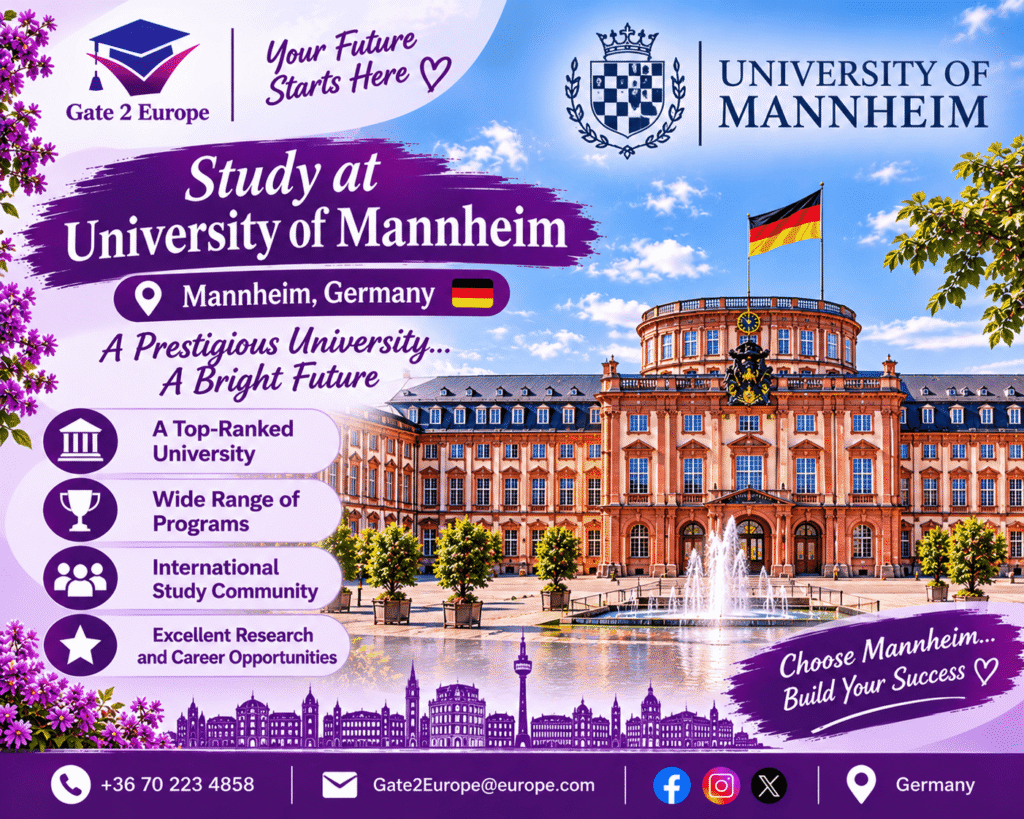
Located in the heart of the state of Baden-Württemberg in southwestern Germany, the University of Mannheim (Universität Mannheim) is one of Europe’s most prestigious and distinguished academic institutions. Widely known in international academic circles as the “Harvard of Germany,” it has earned an outstanding reputation for excellence in Business Administration, Economics, and the Social Sciences. Its campus is equally unique, housed within the historic Mannheim Palace (Schloss Mannheim)—the second-largest Baroque palace complex in Europe after Versailles.
1. (Location, History, and Campus (Universität Mannheim
Location and Campus Environment
Mannheim is located at the confluence of the Rhine and Neckar rivers, holding a strategic position within the major economic and technological hub known as the Rhine-Neckar Metropolitan Region. This location offers students direct access to major global corporations and financial institutions based in the area, as well as in nearby Frankfurt (just 30 minutes away by high-speed train).
The university (Universität Mannheim) campus is an architectural masterpiece. Lecture halls, administrative offices, and libraries are integrated directly inside the grand Baroque Mannheim Palace. This seamless blend of history with modern technological infrastructure gives students an inspiring academic experience.
History and Development
The academic lineage of the site dates back to 1763, when Elector Carl Theodor founded the Electoral Academy of Sciences. The modern institution originated in 1907 as a municipal commercial college (Handelshochschule), established with strong support from the Mannheim Chamber of Commerce.
Over the decades, the college expanded into a full university in 1967. While expanding its scope into the humanities, social sciences, mathematics, and computer science, it has preserved its founding identity as a world-class center for business and economics.
2. (Academic Prestige and International Rankings (Universität Mannheim
The University of Mannheim (Universität Mannheim) holds an elite international status, making it a top choice for international students and researchers worldwide:
Triple Crown Accreditation: The Mannheim Business School is among the less than 1% of business schools globally to hold the prestigious “Triple Crown” accreditation from the three major international accrediting bodies: AACSB (US), AMBA (UK), and EQUIS (Europe).
Rankings: The university (Universität Mannheim) consistently ranks at the top of national league tables (Handelsblatt, CHE) in Germany for Business Administration and Economics. Internationally, it ranks among the top 100–150 universities worldwide in Social Sciences and Economics according to the QS World University Rankings and the Times Higher Education (THE) rankings.
International Environment and Partnerships: Out of more than 12,000 enrolled students, over 20% are international students representing more than 100 countries. Mannheim (Universität Mannheim ) maintains academic exchange partnerships with over 450 leading universities globally (including Princeton University, UC Berkeley, and Sciences Po Paris).
3. (Academic Programs (Universität Mannheim
The university’s (Universität Mannheim) academic structure is organized across five main schools and faculties:
Business School
Department of Economics & Department of Law
School of Social Sciences
School of Humanities
School of Business Informatics and Mathematics
First: Bachelor’s Degree Programs
Bachelor’s degree programs typically span 3 years (6 semesters) and grant degrees such as Bachelor of Science (B.Sc.), Bachelor of Arts (B.A.), or Bachelor of Laws (LL.B.).
1. Business Administration and Economics
B.Sc. Business Administration: The premier undergraduate business program in Germany. It covers marketing, finance, accounting, strategic management, and supply chain logistics. Students can complete coursework in German or select English-taught tracks in advanced stages, along with an optional or mandatory semester abroad.
B.Sc. Economics: Focuses on microeconomics, macroeconomics, economic policy, and advanced econometrics using mathematical and statistical tools.
2. Business Informatics and Data Science
B.Sc. Business Informatics: Combines computer science with business management, teaching students to build and deploy software systems that support managerial decision-making.
B.Sc. Business Mathematics: Emphasizes applied statistics, financial mathematics, and data analytics.
3. Social Sciences and Humanities
B.A. Political Science / Sociology: Renowned for its rigorous quantitative and analytical methodology, focusing heavily on empirical data and field research.
B.A. Media and Communication Studies: Covers modern media, mass communication, and the psychological and social impacts of media.
B.A. Culture and Economy (Kultur und Wirtschaft): An innovative program combining a humanities discipline (such as Languages, History, or Philosophy) with a 30–40% minor in Business Administration or Economics.
Language of Instruction (Bachelor’s): Most undergraduate programs require advanced proficiency in German (C1 level, such as TestDaF or DSH-2), though individual courses and tracks are offered in English.
Second: Master’s Degree Programs
Master’s degree programs at Mannheim (Universität Mannheim) are a major draw for international applicants, as many are taught entirely in English and run over 2 years (4 semesters).
1. Business School Programs (Mannheim Master in Management)
Mannheim Master in Management (MMM): Consistently ranked among the top Master’s in Management programs in Europe. It offers exceptional curriculum flexibility, allowing students to tailor their specialization across accounting, finance, marketing, management, and information systems. The program can be completed entirely in English (or a combination with German).
Master in Business Education: Tailored for careers in human resource development and corporate education.
2. Economics and Data Science
Master in Economics (M.Sc.): A prestigious research-oriented program taught entirely in English. It prepares students for Ph.D. studies or high-level careers in central banks and international institutions such as the European Central Bank and the IMF.
Mannheim Master in Data Science (M.Sc.): Integrates computer science, statistics, and domain knowledge from social and business sciences to train experts in big data analytics and AI applications.
3. Social Sciences and Humanities (English-Taught)
Master in Political Science / Sociology (M.A.): Quantitative research-driven programs focusing on data analysis, taught fully in English.
Master in Intercultural German Studies / Culture and Economy: Interdisciplinary degree tracks combining cultural studies with economic principles.
4. Executive MBA Programs
Offered through the Mannheim Business School, these post-experience programs cater to mid-career professionals and executives (e.g., Mannheim MBA, ESSEC & MANNHEIM Executive MBA, and the Mannheim-Tongji Executive MBA).
Third: Doctoral Programs (Ph.D.)
The University of Mannheim (Universität Mannheim )features a structured doctoral model modeled after top American research universities, organized through the Graduate School of Economic and Social Sciences (GESS).
Structure of the GESS Doctoral Program:
Framework: Rather than relying solely on independent research under a single supervisor, doctoral studies begin with 1–2 years of advanced coursework and methodological training before proceeding to the dissertation phase.
Specialized Centers:
Center for Doctoral Studies in Business (CDSB)
Center for Doctoral Studies in Economics (CDSE)
Center for Doctoral Studies in Social and Behavioral Sciences (CDSS)
Language and Funding: All GESS doctoral tracks are taught in English. Admitted candidates are typically granted full scholarships or research assistantships covering living expenses throughout their 3-to-5-year studies.
4. Student Life and International Student Support
Mannheim (Universität Mannheim) provides a supportive, vibrant environment for incoming international students:
Libraries and Research Infrastructure: Features one of Germany’s most modern university library networks, offering 24/7 digital access to global research databases alongside study spaces inside the historic palace wings.
International Office: Coordinates comprehensive orientation sessions (Orientation Weeks), intensive pre-sessional German language courses, and a Buddy Program that pairs international arrivals with local students for help with administrative procedures and daily life.
Student Housing (Studierendenwerk Mannheim): Offers affordable dormitory accommodations (shared apartments or private studios) near campus, though early application is recommended due to high demand.
Career Network: Thanks to strong ties with industry leaders such as SAP, BASF, PwC, Deloitte, McKinsey, and BMW, the university’s Career Network hosts career fairs and practical workshops to help students secure internships and graduate roles.
5. General Admission Requirements
Academic Credentials: A recognized secondary school diploma (Abitur equivalence or completion of Studienkolleg) for Bachelor’s programs, or a relevant Bachelor’s degree for Master’s admission.
Language Proficiency:
German-taught programs: TestDaF (minimum 4×4) or DSH-2.
English-taught programs: TOEFL iBT (typically 95+) or IELTS Academic (6.5 – 7.0+).
Standardized Test Scores: Certain Master’s programs in Business Administration and Economics strongly encourage or require GMAT or GRE scores to strengthen application competitiveness.
The University of Mannheim (Universität Mannheim )remains an exceptional choice for students seeking a combination of academic rigor, career prospects, and an enriching campus environment in the heart of Europe.
Important Links: