
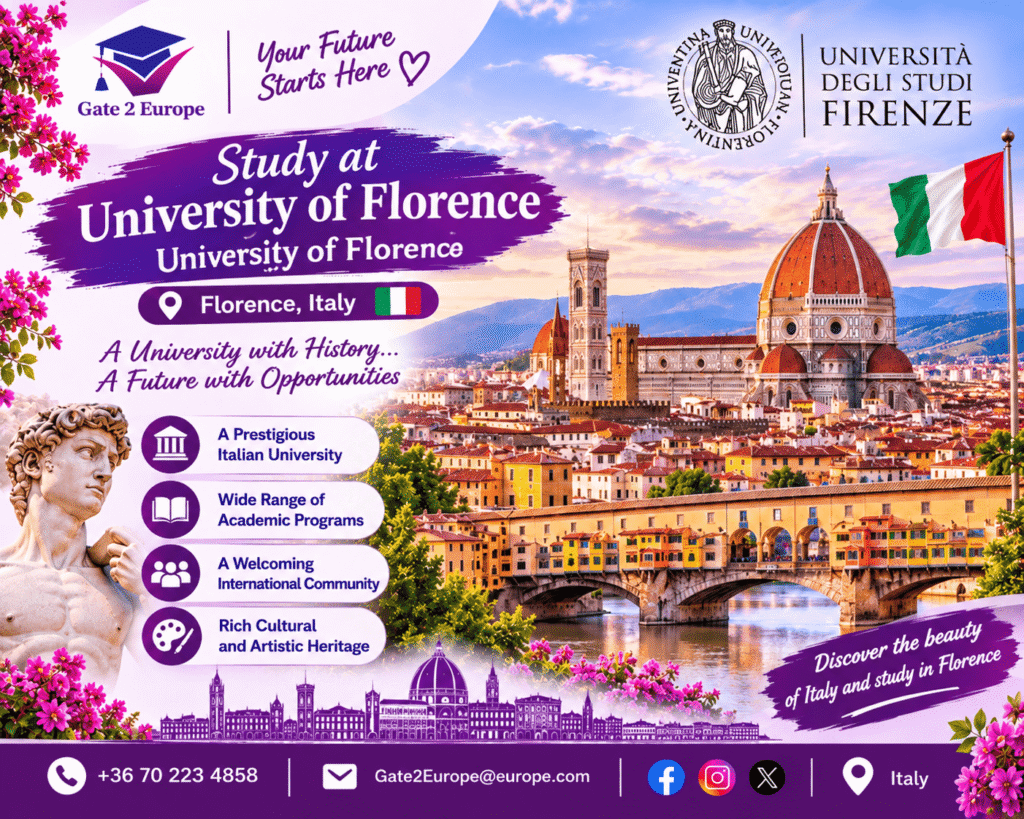
The University of Florence (Università degli Studi di Firenze) is recognized as one of the most prestigious and prominent public research universities in Italy and Europe. This unique academic institution seamlessly bridges the rich heritage of the Renaissance with modern innovation and continuous technological advancement. Holding a distinguished global standing, the university attracts tens of thousands of local and international students seeking high-quality education in an exceptional cultural and urban environment.
1. Geographical Location and Historical Origins
Geographical Location
The campuses and faculties of the University of Florence are integrated into the vibrant rhythm of the historic city of Florence, located in the Tuscany region of central Italy. The university’s facilities are strategically distributed across both historic structures in the ancient city center and modern scientific complexes, including:
Historic Center Campus: Houses the faculties of Humanities, Architecture, and Arts, allowing students to study amid world-renowned Renaissance architectural landmarks.
Novoli Campus (Polo delle Scienze Sociali): Located in the modern district, accommodating the faculties of Economics, Law, and Political Science.
Scientific Campus in Sesto Fiorentino: Features advanced laboratories and the faculties of Mathematical, Physical, and Natural Sciences.
Origin and Historical Development
The historical roots of the University of Florence trace back to the famous Studium Generale, established by the Florentine Republic in 1321. This early institution received official papal recognition in 1349 from Pope Clement VI to confer academic degrees.
Throughout its history, the university has been home to leading figures of human and scientific thought. Illustrious historical personalities such as the physicist Galileo Galilei, the polymath Leonardo da Vinci, and the writer Giovanni Boccaccio taught or worked here. In 1923, the Italian Parliament officially transformed it into the modern, comprehensive University of Florence, which today comprises 21 departments organized across 10 major schools.
2. Importance and Value for International Students
The University of Florence holds a top-tier position, making it a preferred destination for thousands of international students each year for the following reasons:
High Global Rankings: The university consistently ranks among the top Italian universities and within the top 400 to 500 universities globally according to QS and Shanghai rankings, providing significant value and credibility to its graduates’ degrees.
International Accreditation: Degrees awarded by the university are fully recognized across European Union countries via the European Credit Transfer and Accumulation System (ECTS), as well as being listed by ministries of higher education in major Arab and international nations.
Subsidized Tuition and Scholarships: Tuition fees are calculated based on the family’s economic status index (ISEE). Additionally, extensive regional scholarship programs are available, such as the Tuscan Regional Scholarship (DSU Toscana), which covers full tuition fees and offers free or subsidized accommodation, meal vouchers, and a living allowance.
Inclusive Environment and Language of Instruction: The university offers a wide range of degree programs taught entirely in English alongside Italian. Furthermore, its Language Center provides free intensive Italian language courses for international students to support their academic and social integration.
3. Academic Programs (Bachelor’s, Master’s, and Ph.D.)
The University of Florence offers a vast spectrum of academic programs covering diverse theoretical, scientific, and applied fields, structured according to the European higher education system:
A. Bachelor’s Degree (Laurea / First Cycle)
Duration: Typically 3 academic years (accumulating 180 ECTS credits).
Requirements: A high school diploma representing at least 12 years of prior education and passing national or program-specific entry examinations (such as the TOLC tests for Economics and Engineering).
Key Programs Available for International Students (including English-taught tracks):
Sustainable Business for Societal Challenges
Geological Risks and Environmental Sustainability
Civil, Mechanical, and Electronic Engineering
Humanities, Economics, and Political Science
B. Master’s Degree (Laurea Magistrale / Second Cycle)
Duration: Typically 2 academic years (120 ECTS credits).
Single-Cycle Programs (Laurea Magistrale a Ciclo Unico): Combined Bachelor’s and Master’s programs that cannot be divided, lasting between 5 to 6 years for specialized professional fields:
Medicine and Surgery: 6 years
Architecture and Building Engineering: 5 years
Law: 5 years
Pharmacy and Veterinary Medicine: 5 years
Prominent Master’s Programs Taught Entirely in English:
Economics and Development
Urban and Regional Planning and Design for Sustainability
Robotics, Automation, and Electrical Engineering
Finance and Risk Management
Advanced Molecular Sciences and Environmental Biotechnology
C. Doctoral Degree (Ph.D. / Third Cycle)
Duration: 3 years of intensive, supervised academic research.
Program Structure: The university offers advanced Ph.D. tracks linked with European and international consortia (such as the EUniWell alliance), including:
Ph.D. in Urban Future Studies, Architecture, and Cultural Heritage Preservation Design
Ph.D. in Philology, Linguistics, and Italian Literature
Ph.D. in Development Economics and Local Systems (DELoS)
Engineering Doctoral Programs (Civil, Environmental, Industrial, and Information Engineering)
Ph.D. in Physics, Astronomy, and Biomedical Sciences
Conclusion
The University of Florence presents an ideal academic and research environment that blends historical prestige with future-focused academic opportunities. With diverse programs tailored to global market needs, seamless international student integration, and accessible financial support, it stands as a strategic choice for ambitious students aiming to earn an internationally recognized degree in the historic heart of Europe.
Important Links:
Italian Public Universities List for International Students Admission